
VIP Segmentation Strategy for Online Casinos and Sportsbooks
November 18, 2026A rapid support team setup means going from no dedicated team to a staffed, trained and measured player support desk in weeks, not quarters. For a licensed casino or sportsbook, that takes five things in order: a demand forecast, a role and escalation design, documented workflows, a compliance-trained hiring and training plan, and a launch with live metrics. Done well, it takes 4 to 8 weeks. Done badly, it takes six months and still fails on the first jackpot drop.
This guide walks through that sequence for operators serving UK and European players, with the numbers and rules you need at each step.
TL;DR
- Forecast demand per channel before you hire anyone. Use history, the event calendar and your promo plan, and plan for surges, not averages.
- Design roles and escalation first: first-line agents, team leads, second-line specialists for KYC and payments, and QA.
- For UK-facing operators, safer gambling, identity checks and complaints handling must be in the agent workflow on day one, not added later.
- Treat launch as a transition: documented handover, a hypercare period and live service-level metrics.
- A dedicated outsourced team can be live in 4 to 8 weeks with us, with written SLAs and 24/7 coverage.
Table of Contents
- What a rapid player support team actually does
- Step 1: Forecast demand before you hire
- Step 2: Design roles and escalation
- Step 3: Set shifts, languages and service levels
- Step 4: Build the workflows and knowledge base before launch
- Step 5: Build compliance into the agent workflow
- Step 6: Recruit, train and launch in 4 to 8 weeks
- Step 7: Prove readiness with metrics
- Our perspective: why we start with the peak
- How we set up a team
- Common mistakes in a rapid setup
- FAQ
- Sources
What a rapid player support team actually does
The search results for this phrase are dominated by public health and disaster response teams. The principle carries over, though: a small group of trained people is deployed fast against a defined risk. In iGaming, the risk is a support desk that cannot keep up with demand.
The work is time-critical. Zendesk’s account of Kaizen Gaming describes live chat and a 360-degree customer view used for quick support during live sports, where a player may need an answer about their next bet or a cash-out. The same case reports more than 350 agents available 24/7 and 95% first-contact resolution. You do not need that headcount, but the lesson holds: speed and context are part of the product.
You need a rapid setup when:
- You are launching in a new market or language.
- A major tournament or sporting calendar is coming and your internal team cannot staff up in time.
- You are moving from office-hours support to 24/7.
- Attrition or growth has left the desk understaffed and tickets are aging.
- A regulator or licence review has shown gaps in your customer interaction process.
Step 1: Forecast demand before you hire
The most common mistake is hiring to the average week. Support breaks in the peaks.
GOV.UK’s Service Manual says support planning should start by estimating expected enquiry types and volumes, deciding how enquiries will be staffed and defining performance measures, with demand broken down by channel. It also says to use channel-specific average handling time and historical productivity, then derive staffing from a service-level target. Its example is answering 80% of email enquiries within 24 hours.
Apply that to a casino or sportsbook:
- Pull 6 to 12 months of ticket data by channel (live chat, email, ticketing), by hour and by category: payments, KYC, bonuses, technical, complaints.
- Mark the spikes: major tournaments, big fixtures, jackpot drops, bonus campaigns, payday weekends.
- Forecast each channel separately. Zendesk’s iGaming guidance recommends forecasting each channel independently, using historical data plus known events and promotions, and preparing for both expected and unexpected surges.
- Set a service-level target per channel. For example, live chat answered in seconds, email in hours. Staffing follows from these numbers, not the other way round.
- Add a peak multiplier. One vendor source puts betting volume spikes at 5 to 10 times normal during major sporting events. Treat that as a planning range to test against your own data, not a promise.
A worked example: if your baseline is 400 chats a day and you plan for a 5x event day, you must be able to handle 2,000. You will not hire for 2,000 permanently. You design a core team plus a cross-trained reserve pool that can be activated for the event window.
Step 2: Design roles and escalation
A support team is a structure, not a pile of agents. For most operators, the minimum viable structure is:
| Role | Responsibility | Typical scope |
|---|---|---|
| First-line agent | Live chat, email and ticket handling, account and bonus questions | Majority of contacts |
| Team lead / manager | Rostering, coaching, real-time queue control, SLA reporting | One per shift group |
| Second-line specialist | Payments disputes, KYC and verification cases, complex complaints | Escalated cases only |
| VIP / retention agent | High-value player handling, proactive contact | Named player lists |
| QA analyst | Scores conversations, runs calibration, feeds training | Sampled contacts |
Escalation needs a written rule for every category: what the first line can resolve, what must go up, how fast, and to whom. AWS’s operational guidance notes that a culture where escalation is encouraged early and frequently without reprimand helps identify risks before they become incidents. In support terms: an agent who escalates a possible problem-gambling signal or a suspicious withdrawal should be thanked, not questioned.
If you want a ready structure for the written standards behind this, our SOP playbook for player support covers the document set in detail.
Step 3: Set shifts, languages and service levels
Coverage is a scheduling problem. Google’s contact-centre scheduling example shows that rosters must account for language demand and minimum coverage at all times, for instance by assigning agents with the languages forecast for particular days while keeping a baseline number of agents available.
For a UK-facing operator with European traffic, work through these decisions:
- Language by hour, not just by total. Your German-language volume may peak in the evening and your English volume overnight. Roster accordingly.
- Night shifts are not optional if you are 24/7. Plan them as a separate team with its own lead, not as an afterthought for the day team. Our guide to multilingual support for iGaming operators explains how to choose the language set.
- Split shifts and staggered breaks. Zendesk recommends these for peaks, along with a cross-trained reserve pool and monitoring of service level, occupancy, average handling time and backlog age.
- Channel mix. Live chat answers the urgent questions; email and tickets carry documentation-heavy work. If you are unsure how to split them, see live chat versus email for iGaming.
Step 4: Build the workflows and knowledge base before launch
Agents are only as fast as the material behind them. Before the first shift, you need:
- A knowledge base with approved answers for bonuses, wagering terms, deposits, withdrawals and verification.
- Macros and templates for the top 20 contact reasons.
- Runbooks for incidents: payment provider outage, game provider downtime, site-wide login problems.
- A named contact list for incidents on your side.
- Access to your back office, CRM, payment tools and ticketing system, with role-based permissions.
The UK Home Office’s engineering standard lists the same logic for any live service: product purpose, stakeholders and incident contacts, decision logs and runbooks. The Ministry of Justice’s production checklist similarly requires an application support team with contact details, testing, monitoring and agreed extra cover for cutover. Translate that into support: nobody goes live without a runbook and an escalation contact.
Ticketing deserves its own decision. If you are weighing a build against a managed model, read managed support versus in-house ticketing.
Step 5: Build compliance into the agent workflow
In a licensed environment, a fast team that mishandles a verification or a vulnerable customer is a liability. These are the UK points your workflows must cover.
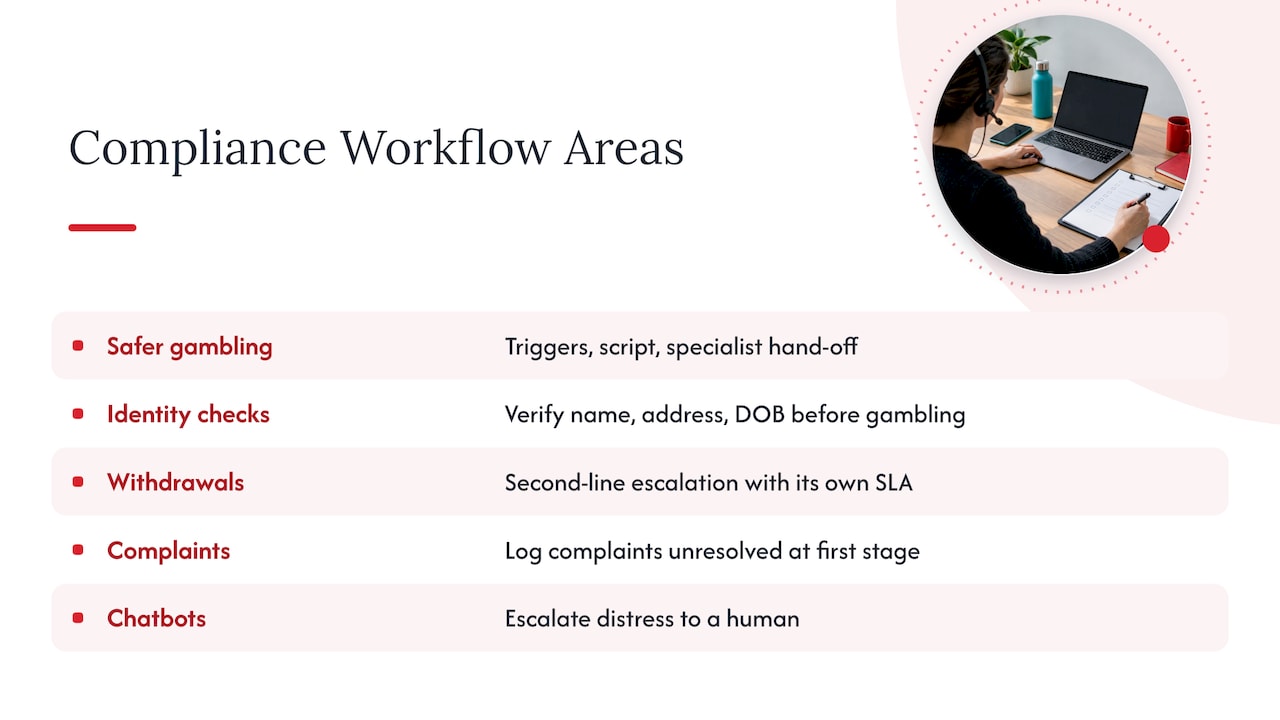
Safer gambling interaction. The Gambling Commission’s guidance says licensees must monitor customer activity from account opening, use a range of indicators to identify harm and take timely action proportionate to the number and level of indicators. The August 2023 version took effect on 31 October 2023 and ties to SR Code provision 3.4.3. Your agents need a clear trigger list, a script for the conversation and a hand-off to a trained specialist.
Identity verification. Under Licence Condition 17, operators must verify name, address and date of birth before allowing gambling, and must not request extra information as a condition of withdrawal if it could reasonably have been requested earlier. The Commission says checks should be done as early as practicable to avoid friction at withdrawal. So your KYC agents should work the queue before the withdrawal request, not after.
Withdrawals. Data submitted by major operators in 2023 indicated that around 99% of withdrawal requests are processed within 24 to 48 hours. Players will measure you against that, so payments contacts need a second-line path with its own SLA.
Complaints. Complaints about licensed activities resolved at the first stage of your procedure need not be recorded for the Commission; other such complaints must be logged. Build the tag and the log into the ticket form. Check the current rules with your compliance officer before finalising.
Automation. If you add chatbots, keep humans on distress. One vendor source says AI should augment human teams on distressed conversations, with risk triggers that escalate to a person, and should not try to counsel alone.
Step 6: Recruit, train and launch in 4 to 8 weeks
Speed comes from running tracks in parallel and from a disciplined handover. The UK government’s delivery guidance on transition says to plan early, define responsibilities and handover points, and have manuals, training and management systems ready before handover, and to keep project-team members available for initial operations.
A realistic plan for a first team looks like this:
- Week 1: scope and design. Confirm volumes, languages, channels, SLAs, tools and escalation paths.
- Weeks 1 to 3: recruit. Screen for language level, written accuracy and composure. Add a team lead early.
- Weeks 2 to 4: access and knowledge. Provision tools, load the knowledge base, agree macros and tone of voice.
- Weeks 3 to 5: training. Product, bonus rules, KYC and safer-gambling modules, tooling, then a test with real past tickets.
- Weeks 4 to 6: shadowing and soft launch. Agents handle a share of live contacts with a reviewer present.
- Weeks 5 to 8: full launch and hypercare. Daily metric reviews, daily calibration of QA scores, fast fixes to the knowledge base.
The timeline compresses or stretches with the number of languages, the tools involved and how quickly access is granted. The biggest delay we see is waiting for system access, so ask for it in week one.
Step 7: Prove readiness with metrics
Do not declare the team ready because it feels busy. Measure it. Zendesk’s list for peak periods is a good core set: service level, occupancy, average handling time and backlog age.
Use these thresholds as launch gates, set from your own SLA:
- Service level met on each channel for five consecutive days.
- Backlog age stable, with no ticket outside the SLA window.
- QA score above your agreed bar, calibrated between your reviewers and ours.
- Every safer-gambling and KYC escalation in the sample handled by the book.
For context on what players see, one licensed 24/7 UK operator publishes an average live chat response time under 30 seconds. Use your own competitive set as the benchmark, not a single example. To check how your chat performs from the player side, try the 5-minute live chat test. Then build a QA programme that keeps scores honest after launch.
Our perspective: why we start with the peak
We build dedicated, named support teams for licensed casinos and sportsbooks from our base in Belgrade, working in EU time zones. When operators come to us, they rarely say “we need a team.” They say “the last tournament broke us.”
So we design backwards from the worst day. We ask what the ticket count looked like at the biggest jackpot or the biggest fixture, then build the roster, the reserve pool and the escalation chain to survive that, and write the SLAs to match. The second thing we insist on is that compliance sits in the workflow, not in a PDF. An agent should see the safer-gambling trigger and the KYC status in the same screen as the chat.
The third thing: do not skip the people layer. A team lead who knows the players, a QA analyst who listens to the conversations and a second line that owns payments cases are what make a team fast and safe at once. Speed without those three is just volume.
— Miroslav Maslovarić
How we set up a team
We hire, train, equip and launch your own named support team in 4 to 8 weeks, covering 24/7 in 14+ languages across live chat, email and ticketing, VIP and retention, KYC and payments, second-line escalation and QA, all under written SLAs. Current rates are listed on our pricing page. See the full pricing page, or read how a dedicated iGaming support team is structured. For peak-heavy calendars, our guide to scaling support without hiring 50 agents shows the model in practice.
Common mistakes in a rapid setup
- Hiring for the average. The first big event exposes it.
- Training on product only. Agents also need KYC, complaints and safer-gambling modules before they see a live player.
- No second line. Payments and verification cases then clog the first line and SLAs slip.
- Launching without a hypercare period. The first two weeks produce most of your knowledge base fixes.
- Treating QA as a later phase. Start scoring in the soft launch.
- Unclear ownership. Name one person on your side for escalations and one on ours.
FAQ
How long does it take to set up a player support team?
In-house, expect several months once recruiting, tooling and training are counted. With a managed provider and ready access to your systems, 4 to 8 weeks is realistic. Our own deployments are built to that window.
What roles does a rapid support team need?
At minimum: first-line agents, a team lead per shift group, second-line specialists for payments and KYC, and a QA analyst. Add VIP agents if you run a high-value programme.
How many agents do we need for a major sporting event?
Start from your own ticket history and apply the peak multiplier you have actually seen. One vendor source cites 5 to 10 times normal volume for major events, but your data should decide. Then split the load between a core team and a cross-trained reserve pool.
Can automation replace a rapid team?
It can deflect simple questions, but distressed customers and verification decisions need humans and auditable rules. Use automation to support agents, with clear escalation to people.
Sources
- Kaizen Gaming bets on fast omnichannel support
- Set up and manage user support, GOV.UK Service Manual
- iGaming customer support strategies for high-demand moments, Zendesk
- Zendesk iGaming peak guidance (UK edition)
- Certainly iGaming support
- AWS Well-Architected, escalation is encouraged
- Google contact centre scheduling example
- Home Office minimal documentation set
- MoJ production ready checklist
- Gambling Commission customer interaction guidance
- Gambling Commission identity verification reminder
- Gambling Commission withdrawals data
- Gambling Commission operational guidance on complaints
- Lorikeet on AI, age verification and responsible gambling
- Transition into use, Government Project Delivery
- Pirots4Play contact page
Recommended