
Customer Support Runbooks for iGaming: A UK Operator’s Guide
November 17, 2026A VIP segmentation strategy for a casino or sportsbook is a written set of rules that decides which players receive enhanced service, why, who looks after them and when they are reviewed. The commercial half is easy: rank players by value. The half that gets operators in trouble is the second one: proving that each VIP was checked for affordability and harm before the perks started. This guide covers both, then shows where an outsourced VIP host team fits.
TL;DR
- Define VIP with explicit, stable rules that combine value (NGR, deposits), behavior (stakes, session patterns, product mix) and trajectory (rising or falling activity).
- Put a protective gate above the value model. Harm markers, failed source-of-funds checks or affordability concerns override any commercial tier.
- For UK-licensed operators, review high value customer accounts at least quarterly, keep an audit trail and name a senior executive accountable.
- Keep customer checks separate from relationship management, whether your hosts are in-house or outsourced.
- Outsourcing VIP hosting works when scope, scripts, escalation paths and QA are written down before launch.
Table of Contents
- What VIP segmentation means in iGaming
- Signals that define a VIP segment
- A tier model that works in practice
- Safer-gambling gates and UK compliance
- Reviewing segment membership over time
- Where support fits into the segmentation model
- Outsourcing VIP hosting: what it covers
- Our perspective: segmentation fails at the handoff
- Working with Workanova on VIP support
- Common mistakes to avoid
- FAQ
- Sources
What VIP segmentation means in iGaming
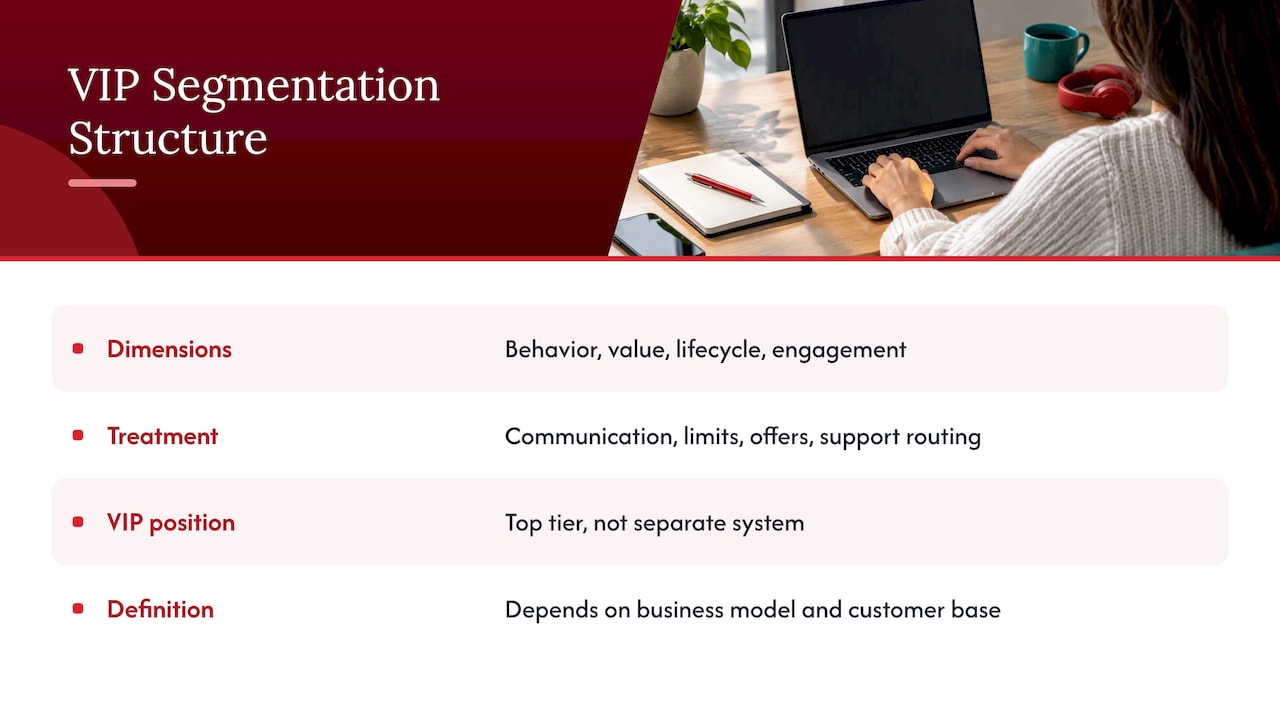
The UK Gambling Commission describes high value customers as those who generate enough commercial value to warrant enhanced treatment, such as personalized incentives, hospitality or dedicated account management, relative to the wider customer base. The same guidance says there is no single definition. Categorisation depends on your business model and customer base, and you should be able to explain your criteria.
That matters for how you build the strategy. Retail playbooks that rank a VIP as the top 5 to 20% of customers by lifetime value do not transfer cleanly. In gambling, the players who generate disproportionate revenue are often the heavily engaged ones, and the Commission’s September 2020 guidance flags the conflict between commercial objectives and regulatory compliance. Your segmentation has to be built with that conflict in mind from the first rule.
In practice, segmentation groups players by behavior, value, lifecycle stage and engagement, so that communication, limits, offers and support routing differ by group. VIP is the top of that structure, not a separate system.
Signals that define a VIP segment
Operators generally draw on three families of signals, as set out in this CRM segmentation overview:
- Monetary: net gaming revenue, deposit volume and frequency, withdrawal ratio.
- Behavioral: session length, stake patterns, product preference (slots, live casino, in-play betting), time of day.
- Trajectory: whether value is rising, flat or declining over recent weeks.
The same overview adds a fourth family that should not be optional: risk dimensions such as harm markers and source-of-funds status. Treat it as its own layer, not as one more input to a score.
Pick thresholds you can defend
Set thresholds from your own data, not from a blog’s percentage. A workable approach:
- Rank 90 days of active players by NGR and by deposits.
- Mark the natural break in the curve, where a small group starts contributing a large share.
- Check that group against behavior. A player with high deposits and erratic, escalating stakes is a different case from one with steady play across products.
- Write the cut-off down, with the date and the reason, so a regulator or auditor can see why a player was in or out.
Keep rules explicit and stable
Industry guidance on segmentation says effective strategies use explicit, stable membership rules, combine value with behavior and lifecycle, refresh regularly, and let protective classifications override commercial ones. If a host cannot explain in one sentence why a player is Tier 2, the rule is too vague.
A tier model that works in practice
There is no standard ladder, but most operators land on four to five levels. The names matter less than the entry rule, the service promise and the owner of each tier.
| Tier | Typical entry logic | Service model | Review trigger |
|---|---|---|---|
| Watchlist (rising) | Value trending up, below VIP threshold | Standard support, priority routing flag | Monthly |
| VIP 1 | Passes value threshold and all checks | Named host pool, fast chat and email SLA | At least quarterly |
| VIP 2 | Higher sustained value, stable behavior | Named individual host, proactive contact | At least quarterly |
| Top tier | Highest value, senior sign-off required | Named host plus senior escalation contact | At least quarterly, plus event triggers |
| Protected / excluded | Any harm marker or failed check | Safer-gambling handling only, no promotions | Immediate, then on case outcome |
The last row is the one that sets the others. Risk and harm markers should act as a gate that overrides value-based segmentation, with players showing harm indicators excluded from promotional segments.
Safer-gambling gates and UK compliance
For operators licensed by the Gambling Commission, the VIP strategy is also a compliance document. The Commission’s 2020 rules announcement says that before a customer is treated as a VIP, you must establish that their spending is affordable and sustainable as leisure spend, assess harm or vulnerability risk, and hold current identity, occupation and source-of-funds evidence.
The industry guidance adds practical controls:
- Failed checks should lead to immediate suspension of VIP treatment.
- Responsibility for customer checks should be separate from HVC relationship management, so the person who benefits from the relationship is not the one approving it.
- A senior executive should be accountable for compliance of the programme.
- You keep an audit trail with records of notable events and customer contact.
Build each of these into the tier table above. Entry to VIP 1 needs a CRM export plus a completed check record. If you want a closer look at the verification side, our KYC outsourcing guide covers how that work is staffed, though it is written with US operators in mind, so apply UK rules where they differ.
Reviewing segment membership over time
VIP status is an ongoing risk assessment, not a trophy. The Gambling Commission guidance says licensees should review HVC accounts at least quarterly unless a risk assessment justifies a different frequency. A sensible review pack for each VIP contains:
- Value and behavior change since the last review (up, down, shifting product mix).
- Any harm markers, limit changes, self-exclusion contacts or complaints.
- Current status of identity, occupation and source-of-funds evidence.
- Every gift, bonus and hospitality item given, with who approved it.
- A decision: keep, move tier, restrict or remove, with the reason.
Add event triggers between reviews: a sudden deposit spike, a run of failed deposits, a request to raise limits, a change in payment method or a complaint. Those should move a player into review the same day, not at the next quarterly date.
Where support fits into the segmentation model
Segmentation is only as good as what happens when a tagged player writes in at 3 a.m. during a big fixture. Three things need to be true:
- The tier is visible to the agent inside the ticketing or chat tool, with a clear routing rule and SLA per tier.
- The agent knows the limits of the role. A host can build rapport and resolve account issues. They cannot waive checks or promise offers outside approved rules.
- Every contact is logged, which feeds the audit trail regulators expect.
The quality of those conversations is measurable. A QA scorecard for VIP contacts should include response time against tier SLA, accuracy on payments and verification status, correct use of safer-gambling language, and whether any commitments were made outside policy. Our player support QA playbook sets out how to build one.
Outsourcing VIP hosting: what it covers
VIP host outsourcing means a partner supplies the people who handle your top-tier players’ day-to-day service, working inside your rules, your tools and your approval chain. Tasks that suit an outsourced team include:
- Fast, named first-line contact for VIP chat and email.
- Account and payment queries, including withdrawal status updates.
- Collecting documents for verification and passing them to your compliance team.
- Proactive check-ins with players, using approved scripts.
- Logging every interaction and flagging risk signals to you.
- Out-of-hours cover when your in-house hosts are offline.
Tasks that stay with you: setting tier thresholds, approving VIP entry, signing off gifts and hospitality, deciding to restrict or remove a player, and the senior accountability the regulator expects. Outsourcing the service does not move the responsibility.
Controls to put in place before launch
For a UK-licensed operator, the controls follow from the guidance above:
- A written scope listing what hosts may and may not do, with prohibited promises spelled out.
- Separation of duties. Hosts relay information and flag concerns; your compliance team decides on checks and entry.
- Approved scripts and offers. Anything outside a rule goes to your team for approval.
- Escalation paths with response times for harm signals, suspected fraud and complaints.
- Full contact logging in your system so the audit trail is yours.
- QA and calibration sessions on a fixed cadence, with scorecards shared.
- Written SLAs per tier, covering response time, availability and coverage in each language you serve.
- Quarterly review input. Hosts supply conversation summaries to the review pack, you make the decision.
Our perspective: segmentation fails at the handoff
We run outsourced player support for licensed casino and sportsbook operators, and the pattern we see is consistent. Segmentation models are usually fine on paper. They break at the handoff between the CRM team that defines the tiers and the people who answer the player. The tier is in a spreadsheet, the agent cannot see it, and a top-tier player waits in the general queue during a jackpot drop or a major sporting event.
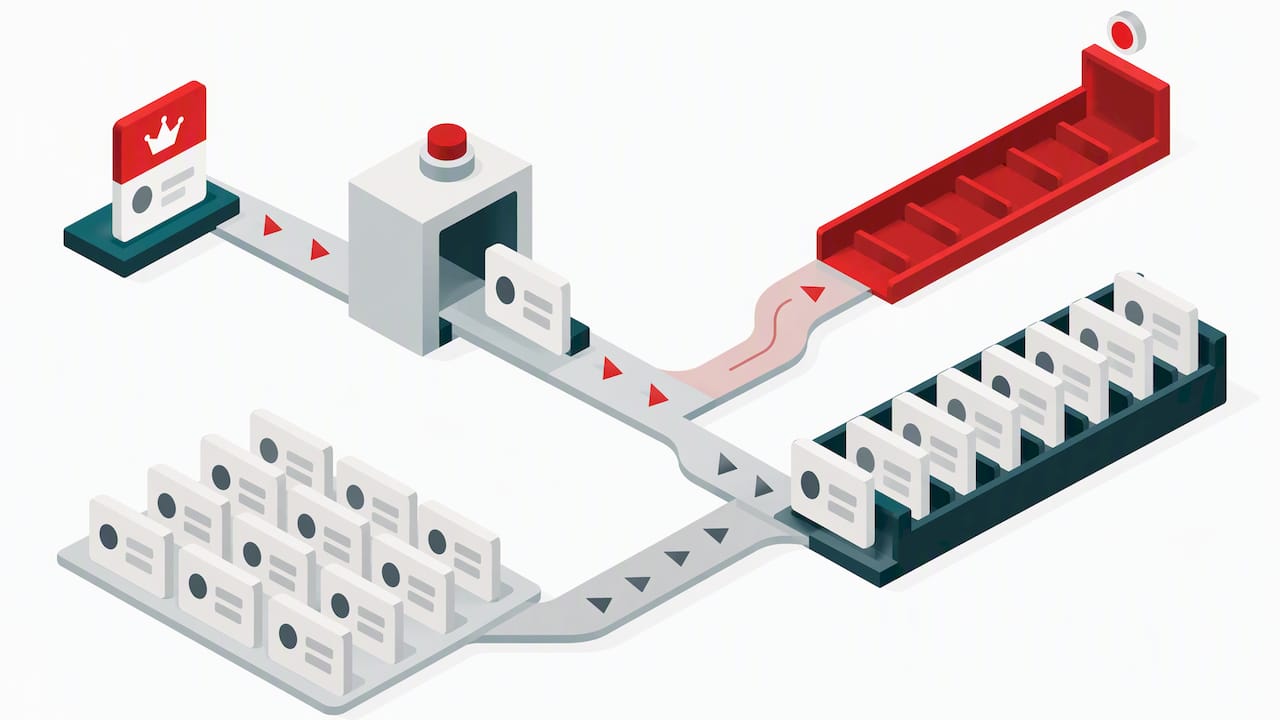
Our advice is to design the tiers backwards from the service. Decide first what a VIP 1 player is promised, then check you can staff that promise at your busiest hour, in the languages your players use, around the clock. If you cannot, the tier is a label, not a service. Peaks are where this shows: volume multiplies, in-house teams cannot staff up in time and the first people to feel it are the players you most want to keep.
The second point is governance. A dedicated, named team that works to your written rules and SLAs, with QA on every VIP contact, gives you a cleaner audit trail than ad hoc cover from whoever is on shift. We can launch a dedicated team in 4 to 8 weeks, which is quick enough to put in place before a major event rather than after it.
— Miroslav Maslovarić
Working with Workanova on VIP support
Workanova is a Belgrade-based BPO working in EU time zones. We build named, dedicated support teams for licensed iGaming operators, with 24/7 coverage in 14+ languages, and our VIP player support service is designed to sit inside your segmentation and compliance rules. Current rates are listed on our pricing page. For a wider view of what we do for casinos and sportsbooks, start at our iGaming page, or read how operators cut VIP casino support setup costs.
Common mistakes to avoid
- Defining VIP by deposits alone. High deposits with harm markers is a risk case, not a reward case.
- Static tiers. If nobody has moved down a tier in a year, the review is not working.
- Hosts who also approve entry. It breaks the separation the guidance expects.
- No audit trail for gifts. Record who approved each item and why.
- Invisible tiers. If agents cannot see the tier, SLAs are decoration.
- Copying retail segmentation. Percent-of-base rules from ecommerce do not account for source of funds or harm.
FAQ
What is a VIP segmentation strategy in iGaming?
It is a documented framework that decides which players get enhanced service, based on value, behavior and lifecycle, and which are excluded for risk reasons. In the UK it also has to show that affordability, harm and source-of-funds checks were done. It covers the criteria, the service for each tier, the owners and the review cycle.
How many players should be in a VIP segment?
There is no fixed share. Retail guides often cite 5 to 20% of customers, but the Gambling Commission says definitions depend on your business model and customer base. Set the threshold from your own revenue curve and write down the reasoning.
How often should VIP accounts be reviewed?
For UK-licensed operators, the Commission’s guidance says at least quarterly, unless a risk assessment justifies a different frequency. Also review immediately on trigger events such as deposit spikes, limit increase requests or complaints.
Can VIP hosting be outsourced to a BPO?
Yes, the day-to-day service can be. Contact handling, status updates, document collection and proactive check-ins suit a dedicated external team. Tier thresholds, VIP approval, gifts and the decision to restrict a player stay with your compliance and management team.
What should an outsourced VIP team’s SLA include?
Response and resolution times by tier, coverage hours and languages, escalation times for harm or fraud signals, QA scoring cadence and contact logging requirements. Write them into the contract rather than into a handbook.
Sources
- High Value Customers: Industry guidance, Introduction (Gambling Commission)
- High Value Customers: Industry Guidance, September 2020 (Gambling Commission)
- New rules to stamp out irresponsible VIP customer incentives (Gambling Commission)
- Customer Segmentation for Gaming Operators (OptiKPI)
- Player Segmentation and Value Tiers in iGaming CRM (Lora)
- Segmentation That Supports Decisions (iGaming Times)
Recommended