
Responsible Gambling Referrals: A UK Operator’s Guide
November 13, 2026Good queue prioritization rules do one job: they decide which player ticket is answered next, and they make that decision the same way every time. For a UK-licensed casino or sportsbook, that means ranking tickets by urgency and player risk rather than arrival order, defining what happens when two tickets tie, and making sure a low-priority ticket never ages out of sight. This guide gives you a working rule set, the overrides the Gambling Commission expects you to build in, and the forecasting inputs that tell you when the backlog is about to outrun your team.
TL;DR
- Rank by urgency and impact, not arrival time. Safer-gambling signals and withdrawal or access problems sit above general questions.
- Write a tie-break rule and an aging rule before launch. Without them, FIFO quietly decides for you and low-priority tickets starve.
- Measure wait time per priority class and per player segment, never one overall average.
- Forecast by channel from historical data and the fixture and promo calendar, and set staffing triggers on backlog age, not only on volume.
- Review the rules on a schedule. UK licensees must evaluate whether their customer interaction approach works, and prioritization is part of it.
Table of Contents
- Why first-in, first-out fails a gambling support desk
- Build the priority scale
- Overrides: when category must not decide the priority
- Ties, escalation and aging
- Measure whether the rules work
- Forecast ticket arrivals and backlog
- Our perspective: rules fail at peak, not on a quiet Tuesday
- Put the rules into an SOP
- Staff the rules with a managed team
- FAQ
- Sources
Why first-in, first-out fails a gambling support desk
First-in, first-out feels fair. In practice it is a policy like any other, and it ignores what is in the ticket. A player asking about a bonus wagering rule and a player who says they cannot stop gambling both wait their turn, and the second ticket is the one that can cause real harm and a regulatory problem.
Queueing theory makes the trade-off explicit: priority improves service for one class by making another class wait. That is the whole point of prioritizing, but it is also the risk. Every rule you write for who goes first is also a rule for who goes last, so the last class needs a ceiling on its wait.
So a good rule set has four parts:
- A priority scale with clear definitions.
- Overrides that lift a ticket regardless of its category.
- A tie-break and an aging rule.
- Measures that show whether it all works.
Build the priority scale
Keep it to four levels. More than that and agents argue about the boundary between level five and level six instead of answering players. Route by urgency, not by who saw the ticket first: a practical iGaming support guide puts widespread service disruption and time-sensitive player-protection requests in the urgent category, with payment, account-access and transaction problems needing prompt investigation one step below.
A scale we see work for licensed operators:
| Priority | What goes here | Example tickets | Typical first-response target |
|---|---|---|---|
| P1 Urgent | Player-protection requests, platform-wide outages, suspected account takeover | Self-exclusion or time-out request, “I cannot stop”, site down during a live event | Minutes, live handling |
| P2 High | Money or access blocked for one player | Delayed withdrawal, failed deposit, locked account, KYC blocking a payout | Under an hour in staffed hours |
| P3 Normal | Questions that affect play but not money | Bonus terms, game rules, verification status | Within the same shift |
| P4 Low | General or informational | Feature requests, feedback, account-detail changes | Within the business day |
Treat the response targets as placeholders. Set yours from your own history and write them into the SLA. Response and resolution targets can be set per priority level, and each level needs both: a first-response target and a resolution target.
The classification itself should not rely on how angry the player sounds. A sound triage design classifies by impact, urgency and category, and uses flags to surface possible incidents or security concerns instead of reading tone. Tone is useful as a signal. It is a poor sole criterion, because it rewards the loudest player and penalizes the polite one.
Overrides: when category must not decide the priority
A category-based scale breaks the moment a ticket arrives labelled “bonus question” that contains a vulnerability signal. You need overrides that outrank the category.
Safer-gambling and vulnerability overrides
Under the Gambling Commission’s remote customer interaction condition, licensees must run effective systems that identify, act and evaluate, and the Commission describes interaction as an ongoing process rather than a one-off event. The same condition lists the indicators operators must consider, including spend, spending patterns, time spent gambling, behaviour, customer-led contact and use of gambling-management tools. Customer-led contact is your support queue.
In practice, build a keyword and context flag that lifts a ticket to P1 when it mentions:
- losing control, chasing losses, or financial distress;
- a request for a time-out, self-exclusion or lower limits (operators must offer a time-out facility of 24 hours, one week, one month or up to six weeks);
- an account already flagged by your harm-indicator system.
The action must also fit the player. The Commission’s guidance describes a tiered interaction system, from early tailored action for low-risk indicators up to refusing service or ending the relationship for persistent risk. Your queue rule should hand these tickets to a trained agent or your safer-gambling team, not leave them in the general pool.
Money and access overrides
Withdrawals are the largest single friction point. The Commission has said withdrawal problems were its number-one consumer contact topic in July 2023, and that some of the largest operators process around 99 percent of withdrawal requests within 24 to 48 hours. The remaining cases are the ones that reach your queue, and they are the ones that turn into complaints. In the Commission’s most recent quarterly complaint data, withdrawals and financial transactions accounted for 391 of 1,757 contacts, and customer service issues for 294.
Useful money overrides:
- A withdrawal pending longer than your stated processing window moves up one level automatically.
- A KYC document request that blocks a payout inherits the priority of the payout, not of a document question.
- A second contact about the same unresolved issue moves up one level.
Complaint overrides
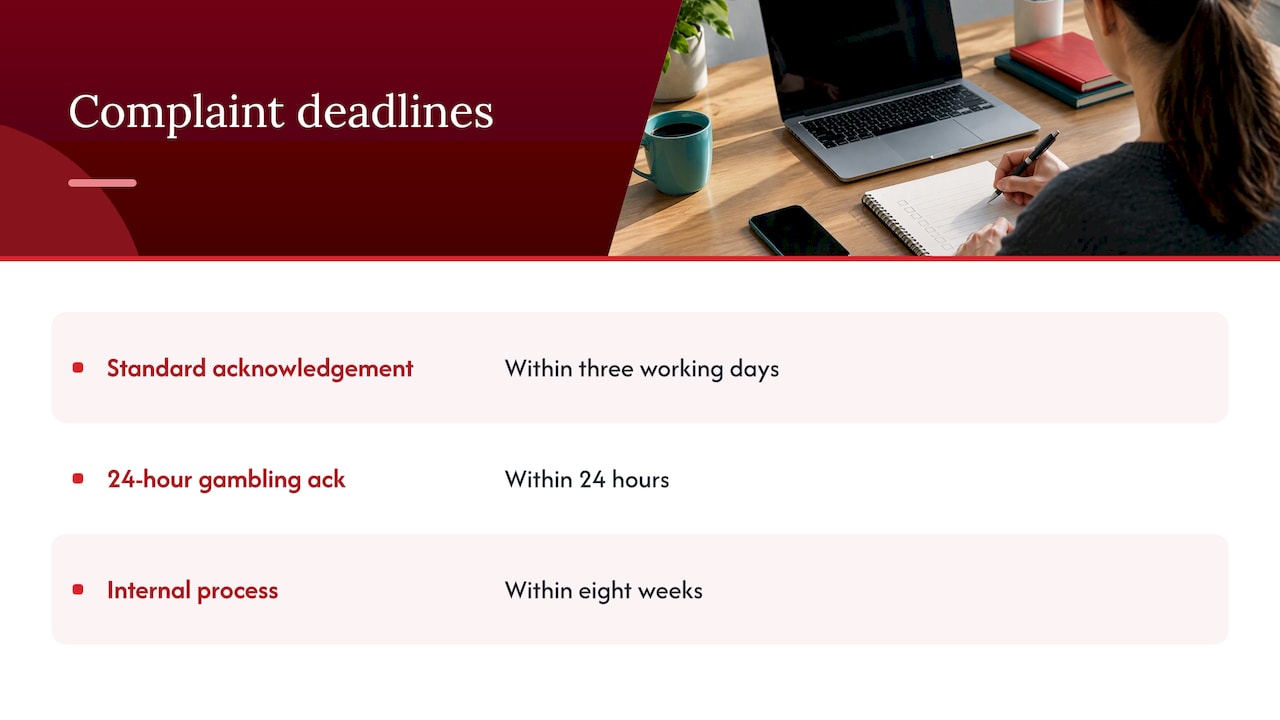
Separate ordinary support from formal complaints. Commission guidance expects a clear written process, acknowledgement within three working days, or within 24 hours where you offer 24-hour gambling, and completion of the internal process within eight weeks. A ticket that becomes a complaint should leave the standard queue and carry its own clock. Operators also record complaints not resolved at the first stage, so your tagging needs to distinguish first-stage resolution from escalation.
Ties, escalation and aging
This is where most rule sets stop, and where queues go wrong. A priority rule should specify both how priority is assigned and what happens when priorities tie. Here is a complete version.
Resolve ties in a fixed order
When two tickets share a priority level, order them by:
- Time remaining until SLA breach, shortest first.
- Number of previous contacts on the same issue, highest first.
- Player segment, where your policy defines one (for example VIP handling).
- Arrival time.
Arrival time is the last resort, not the first. Ordering by time-to-breach means a P3 ticket that is minutes from its target outranks a fresh P3 ticket, which is what a fair queue should do.
Let priority change as the case changes
A ticket’s priority is not fixed at intake. Write escalation triggers that fire on events:
- The player replies with new information (re-triage).
- Second-line support finds a payment or compliance dependency (raise to P2).
- The ticket reaches 75 percent of its resolution target (alert the team lead).
- A harm indicator appears on the account after the ticket was opened (raise to P1).
This is why a separate second line matters. Agents on the first line handle the standard questions; anything needing payment-system access, fraud review or compliance judgment needs a defined second-line escalation path with its own queue and its own targets, or those tickets sit in P2 while everyone waits for someone else.
Stop low-priority tickets aging forever
With strict priority and a busy day, P4 never gets served. The standard remedy is priority aging: a waiting ticket is promoted once it has waited a maximum time, which caps its worst-case wait. The same source warns that aging can create oscillation, where a burst of promoted tickets occupies agents while fresh high-priority work waits.
Two ways to avoid the oscillation:
- Promote in steps. Move a ticket up one level at a time, at fixed ages (for example P4 to P3 after one business day, P3 to P2 after the shift ends without a reply). Do not jump straight to the top.
- Reserve capacity. Assign a small share of agent time each shift to the oldest tickets, so aged work drains steadily and not in bursts.
Pick the aging thresholds from your own data, and review them after your first peak.
Measure whether the rules work
The UK regime asks for this directly. The Commission expects operators to take reasonable steps to evaluate the effectiveness of their approach, for example by trialling and measuring impact, and to be able to demonstrate the outcomes. Prioritization rules are part of that evidence.
Track these, each split by priority class:
- First-response time and resolution time (median and 90th percentile, never only the mean).
- Backlog age: the age of the oldest open ticket per class.
- Reopen rate and second-contact rate.
- Abandonment on live chat, meaning players who leave before an agent answers.
- Share of tickets promoted by aging rules (a high number means your base targets are wrong).
Measure waiting separately by class, because one overall mean hides the class that is being sacrificed.
Check for unfair disadvantage
A queue can disadvantage a group without anyone intending it. A University of York working paper on English emergency departments found that women, ethnic minorities and residents of deprived areas were systematically deprioritized, especially when departments were busy. That is a hospital setting, not a casino, but the mechanism carries over: pressure on a queue is when informal bias appears.
For a support desk, run a monthly check of wait times by language, channel, player segment and time of day. If non-English speakers wait longer because only a few agents cover their language, that is a staffing gap to fix. If players who write short, informal messages are triaged lower, that is a QA finding. Sampling classified tickets for review is exactly what a structured QA program is for.
Forecast ticket arrivals and backlog
Rules decide order. Forecasting decides whether there are enough agents for the order to matter.
Inputs
Guidance for iGaming support teams is to build separate forecasts per channel from historical data and current trends, model both expected and unexpected surges, update as new data arrives, and monitor service level, occupancy, average handling time and backlog age. Match-day peaks need the fixture list modeled in advance, plus reserve pools of cross-trained agents.
Match days compress registration, deposit and in-play dispute contacts into a few hours, so the playbook needs to define what is automated and what needs a human.
Historical data worth pulling:
- Hourly ticket arrivals per channel for at least the last 12 months.
- Arrivals around past major tournaments, jackpot drops and promotion launches.
- Average handling time per category, because a P2 withdrawal ticket takes far longer than a P4 question.
- Abandonment and reopen rates.
- The calendar ahead: fixtures, promo schedule, payment-provider maintenance windows.
Choose the staffing model carefully
The Erlang C formula is a standard staffing estimate, but it assumes no one abandons, so it often overestimates the staff you need. Erlang A models, which account for abandonment, are increasingly used for that reason. For live chat, where players do leave, the abandonment-aware model is the better starting point. For complex multi-skill routing, validate your plan by simulation.
Staffing triggers
Set triggers on backlog age, not only volume, because a backlog of old tickets is the real warning sign. Monitoring backlog age during high-demand periods helps keep responses timely and limits player frustration.
Example trigger ladder (calibrate to your own numbers):
- Oldest P2 ticket reaches 50 percent of its resolution target: team lead reallocates agents from P3 and P4.
- Forecast shows the next shift exceeding capacity: call in the reserve pool.
- Oldest P2 ticket breaches target twice in a day: activate overflow capacity.
The third step is where an in-house team usually runs out of options, because hiring and training take weeks.
Our perspective: rules fail at peak, not on a quiet Tuesday
We run dedicated player support teams for licensed operators, and the same pattern repeats. The rules look fine in the documentation. They break when a jackpot drops, a major match kicks off, or a promo goes out and ticket volume multiplies in an hour. At that point three things go wrong: the P1 definition is too wide so everything is urgent, nobody owns the aging rule, and the team has no one to hand overflow to.
Our advice is plain:
- Keep P1 narrow. If more than a small share of tickets are urgent, the label has lost meaning.
- Give every rule an owner and a review date.
- Rehearse a peak before the real one, with the reserve pool and the escalation path.
- Put the targets in a written SLA, so a miss is visible and not argued.
A queue policy is only as good as the capacity behind it. That is why we build named teams that can be launched in four to eight weeks and sized for peaks, instead of asking operators to staff for the worst day all year.
— Miroslav Maslovarić
Put the rules into an SOP
A rule that lives in one manager’s head is not a rule. Write the scale, overrides, tie-breaks and aging steps into the support SOP, and train every agent on the same version. Our SOP playbook for operators shows how to structure that document. If your ticketing tool cannot enforce sorting by time-to-breach, that is a reason to review the setup; see how managed ticketing compares with running it in-house.
Staff the rules with a managed team
If your queue rules are sound but you cannot staff the peaks, we can run the department for you. Workanova builds dedicated player support teams for licensed operators, with 24/7 coverage, live chat, email and ticket support, VIP handling, KYC and payments, second-line escalation and QA, all under written SLAs.
Current rates are listed on our pricing page. See the full pricing page for details.
If you want your priority scale and SLAs reviewed against a realistic peak plan, talk to us about a dedicated team.
FAQ
How many priority levels should a casino support queue have?
Four is a good default: urgent, high, normal and low. It is enough to separate player-protection and outage issues from money problems and general questions, and few enough for agents to apply consistently. Add segment rules such as VIP handling as tie-breakers, not as extra levels.
Should VIP players always go first?
Not above player-protection or access and payment problems. Treat VIP status as a tie-break inside a priority class, or give VIPs a dedicated team and queue with their own targets. A VIP asking about a bonus should not outrank any player who has asked for a time-out.
How do I stop low-priority tickets waiting forever?
Use stepwise aging: promote a ticket one level when it passes a set age, and reserve a share of each shift for the oldest tickets. Review how many tickets get promoted. If the number is high, your base targets or your staffing are off.
How often should I review queue prioritization rules?
Review them after every major peak, and on a fixed schedule at least quarterly. Compare wait times by class and segment, check the share of tickets promoted by aging, and adjust thresholds. UK licensees are expected to evaluate and be able to show how their customer interaction approach performs.
Sources
- iGaming Player Support: A Practical Guide
- Support Ticket Triage Runbook Template
- The Third Bit: Priority Starvation
- Gambling Commission: LCCP Condition 3.4.3, Remote customer interaction
- Gambling Commission: LCCP Condition 3.3.4, Remote time-out facility
- Gambling Commission: Customer interaction guidance
- Gambling Commission: Exploring the topic of withdrawing funds
- Gambling Commission: Customer complaints about licensees
- Gambling Commission: Complaints handling requirements
- Gambling Commission: Regulatory returns guidance
- University of York: Disorderly Queues
- Zendesk: iGaming customer support strategies for high-demand moments (UK)
- Zendesk: iGaming customer support strategies for high-demand moments
- Comm100: Dealing with Match Day Surges
- ICMI: Service Level Notes
- Technion: Service Engineering in Action, the Palm/Erlang-A Queue
Recommended