

Promo Spike Planning for iGaming Player Support
November 23, 2026A support localization strategy is a plan for delivering player support in each market language with the same compliance quality, service levels and tone in every queue. For a UK-licensed casino or sportsbook, that means more than translating macros. You need native-language agents, localized regulatory wording, language-specific QA and escalation paths that connect to your player-risk systems. This guide shows you how to build that, step by step.
TL;DR
- Treat localization as an operating system for support, not a translation project: scope languages, segment queues, localize playbooks, train, integrate, measure.
- If you market in a foreign language, the UK Gambling Commission expects safer-gambling information, player guides and summary terms to be available in that language.
- Complaints, KYC and safer-gambling contacts are where localization fails first. Design those flows before you design greetings.
- Outsourcing adds capacity but never moves accountability. The licence holder stays liable, so contract for audit rights, record access and named escalation owners.
- Test quality per language on live tickets, not on a glossary.
Table of Contents
- What support localization means for a regulated operator
- Why the UK Gambling Commission changes the brief
- Building the strategy in seven steps
- KYC and payments: localize the explanation, not just the form
- Complaints in every language
- Outsourcing localization without outsourcing accountability
- The KPIs that show whether localization works
- Peak events stress every language at once
- Our perspective: governance central, delivery native
- What it costs to staff localized queues
- Launching localized support with Workanova
- FAQ
- Sources
What support localization means for a regulated operator
Most guides on localization strategy cover websites, marketing and brand. Support is different. Every ticket is a live interaction with a regulatory dimension: a player asking why a withdrawal is pending, disputing a bonus term or hinting that they are losing control.
For an operator, a localized support function covers five layers:
- Language: native-level agents, not agents working from a translation tool.
- Content: macros, help-centre articles, templates and chat flows in each language, owned centrally and reviewed against your terms.
- Regulation: the rules that apply to the player’s jurisdiction, applied in the player’s language.
- Process: KYC, payments, complaints and safer-gambling escalations that work the same way in every queue.
- Measurement: service and compliance KPIs reported per language, not as one blended average.
If one layer is missing, the others look fine on a dashboard while players in one language get a worse and riskier experience.
Why the UK Gambling Commission changes the brief
UK rules make localization a compliance topic. Three provisions shape the design.
Foreign-language marketing. Under LCCP ordinary code provision 3.3.2, operators marketing in languages other than English should make responsible-gambling and help information, required player guides and summary contractual terms available in each of those languages. This is ordinary code rather than a licence condition, but any departure should be justified and shown to be similarly effective. Your support team is the front line for these materials, so your macros and knowledge base need to match.
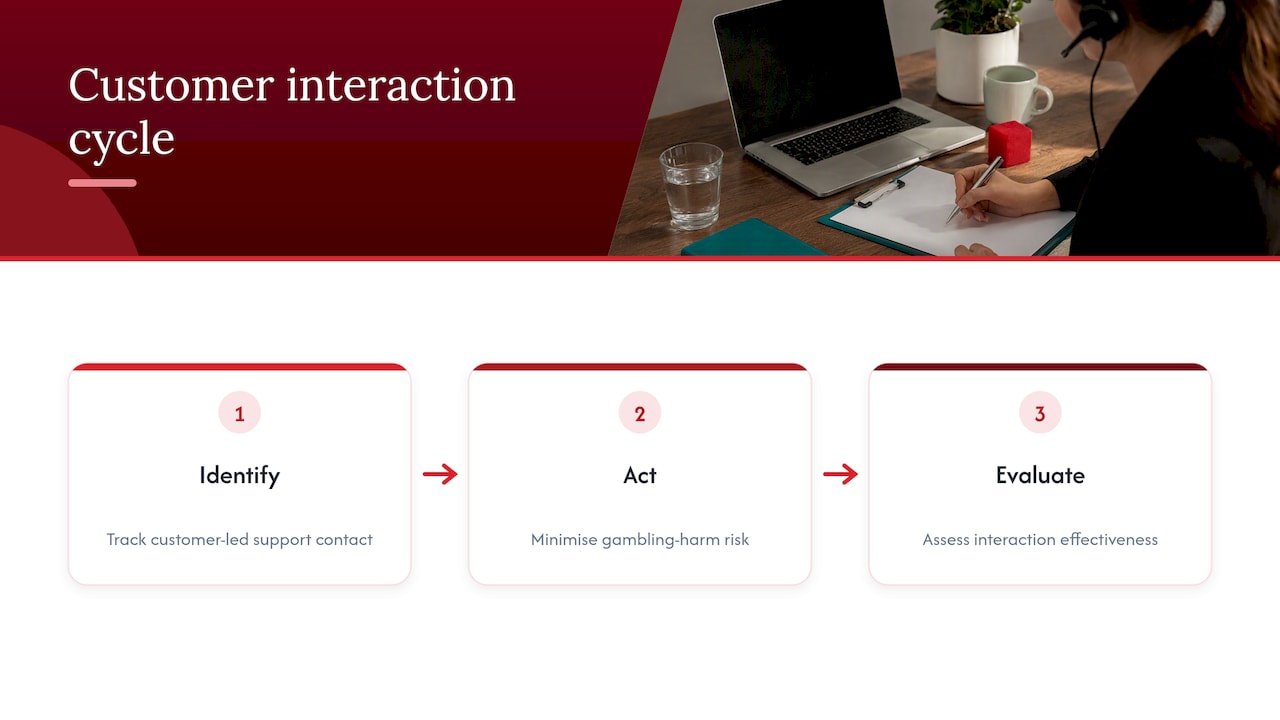
Continuous customer interaction. Social responsibility code 3.4.3 requires effective customer interaction systems that minimise the risk of gambling harm. The Commission’s customer interaction guidance describes an ongoing process of identifying, acting and evaluating. Monitoring starts when the account opens, and customer-led contact is one of the indicators to watch. A support contact is therefore data, not just a ticket to close.
Complaints. The Commission’s complaints guidance says handling must be fair, open, transparent and accessible. For 24-hour gambling facilities, acknowledgement should come within 24 hours. The internal process must end within eight weeks, after which unresolved disputes go to a free alternative dispute resolution route. Condition 6.1.1 sets the underlying duty.
The practical result: a language queue that only translates and closes tickets can miss a safer-gambling signal or mishandle a complaint, even if its response times are excellent.
Building the strategy in seven steps
1. Define language and regulatory scope
Start from the markets you actually market to, not from a language count. For each one, record:
- the language and any regional variants (for example, German for Germany, Austria and Switzerland)
- the licence or regulatory regime that governs the player
- peak hours and the time zones of your players
- which products and payment methods are live
This list drives hiring, queue design and which materials need localizing under the foreign-language provision above.
2. Segment queues by language and risk
Do not run one big queue with a language tag. Split by language first, then by contact type: general enquiries, payments, KYC, VIP, complaints and responsible-gambling contacts. Risk-bearing contacts need routing rules that work in every language. A player who mentions chasing losses in Finnish must reach the same escalation path as one who says it in English.
3. Localize macros, knowledge base and templates
Central ownership matters. Keep one source of truth for terminology: wagering requirements, bonus terms, self-exclusion, deposit limits, “pending” versus “processing” for withdrawals. Native-language agents then adapt tone and phrasing inside those guardrails.
Test the high-risk content in live workflows: promotions, wagering conditions, payment failures and safer-gambling interventions. A glossary review will not catch a macro that sounds polite and is legally vague.
4. Train agents on jurisdiction-specific rules
Agents need playbooks, not slide decks. Each playbook covers a scenario (a self-exclusion request, a chargeback threat, a bonus dispute, a document rejected for the third time), the exact wording rules, what to record and who to escalate to. Train per market, because the same request can have a different correct answer depending on the licence.
5. Connect support to CRM, KYC and payments
Agents who cannot see account status, verification history and payment state will guess. Integrate your CRM, KYC provider and payment back office so agents can see context, and make sure interaction records feed your risk and safer-gambling monitoring. This is also what lets QA verify what happened afterwards.
6. Set KPIs per language
Blended metrics hide weak queues. Report every KPI by language (see the table below) and review them in the same weekly meeting, with compliance in the room.
7. Review and iterate on a release cycle
Every terms update, new promotion or payment method creates localization work. Tie support content updates to your release calendar so macros and help articles change on the day the product does, in every language.
KYC and payments: localize the explanation, not just the form
Condition 17.1.1 requires UK-facing operators to obtain and verify identity information, including name, address and date of birth, before a customer is permitted to gamble. The Commission also says operators should not impose, at withdrawal, an information requirement they could reasonably have requested earlier. Customers should be told before depositing what documents may be needed, when and in what form.
For support, this changes what “good” looks like:
- Agents explain requirements early and consistently, in the player’s language.
- Rejection messages say what was wrong with a document and how to fix it, rather than repeating a generic request.
- Agents may also field questions on contact details, for example how a customer goes about verifying a UK phone number, so your help content should cover it in each language.
- KYC is measured on accuracy and avoidable rework, not only speed.
Payments follow the same logic. A failed deposit or delayed withdrawal is the most emotional ticket you will see, and a vague translated reply escalates it. Build payment-status macros per method and per language, and track payment-resolution time by queue. For more on this workstream, see our guide to KYC outsourcing for iGaming operators.
Complaints in every language
Complaints localization is a trust function. If a player cannot understand the complaint route, the timescales, the wording of the final position or the ADR option, a translated first reply does not meet the standard of an accessible process.
Build a complaints playbook per language that covers:
- How to recognize a complaint versus a query, with examples in that language.
- The acknowledgement template and the 24-hour clock for round-the-clock facilities.
- The escalation owner and the eight-week internal limit.
- Final-position wording and ADR referral text, approved centrally.
- Record keeping that lets you track complaint ageing per language.
The Commission’s guidance on time limits and escalation is worth reading with your compliance lead before you finalize the process.
Outsourcing localization without outsourcing accountability
Many operators cover less common languages and night hours through a managed support partner. That is legitimate, but the Commission’s position is clear. In its guidance on reliance, an operator may use an agent or outsourcing provider for customer due diligence activity, but the operator remains liable for any failure. Arrangements must allow immediate access to identification and verification data and the relevant documents. The Commission’s note on licensees’ responsibilities for third parties reinforces that the licence holder stays the responsible party.
So judge a vendor on evidence and control, not on language count. Ask for:
- audit rights and real-time access to KYC evidence and interaction records
- incident notification timelines
- an approved list of subprocessors, with changes subject to your consent
- named escalation owners on both sides
- per-language QA scorecards you can inspect
- a written data-protection map: controller and processor roles, retention, and where agents access personal data. UK GDPR and EU GDPR transfer rules can apply when staff outside the UK or EEA access player data, so confirm the transfer mechanism before launch.
Our guide on choosing an iGaming BPO partner without adding risk turns this into a due-diligence checklist, and the outsourcing guide for operators covers the commercial model.
The KPIs that show whether localization works
Track these per language, never only as a blended total.
| KPI | What it tells you | Watch for |
|---|---|---|
| First response time | Whether queues are staffed for their real peaks | One language consistently slower at night |
| Resolution time and backlog | Whether agents can actually solve issues | Growing backlog in a small language |
| SLA attainment | Contract performance | Averages hiding a failing queue |
| QA score by language | Tone, accuracy and compliance wording | Scores that differ by reviewer, not by agent |
| Escalation accuracy | Whether risky contacts reach the right owner | Safer-gambling cases handled as general queries |
| KYC completion and rework | Friction in verification | Repeat document requests |
| Payment-resolution time | Trust in withdrawals | Method-specific delays |
| Complaint ageing | Regulatory exposure | Cases nearing the eight-week limit |
| Safer-gambling intervention timeliness | Whether you act promptly on indicators | Delays between contact and action |
Language QA deserves its own process, with native-speaking reviewers who score against your terminology and compliance criteria. We describe the approach in our piece on language quality assurance for iGaming.
Peak events stress every language at once
A jackpot drop, a major tournament or a promotion can multiply ticket volume within hours, and the smaller language queues are usually the thinnest. Plan peak coverage per language: forecast volume, pre-approve temporary macros, brief agents on the promotion terms and agree escalation cover. Our pages on scaling player support without adding risk and World Cup support coverage go deeper on this.
Our perspective: governance central, delivery native
We run dedicated player support teams for licensed operators from Belgrade, in EU time zones, with 24/7 coverage in 14+ languages. What we see most often is operators treating language as a headcount question: how many Italian agents, how many German. The harder question is who owns the playbook when an Italian-speaking player writes something that signals harm at 3 a.m.
Our view is that terminology, responsible-gambling language and escalation rules should be governed centrally by the operator and the support partner together, then delivered by native-language agents who know the market. We build the named team in 4 to 8 weeks, so the operator gets a department with its own brand voice, rather than a pool of shared agents. Written SLAs and QA by language make that team inspectable.
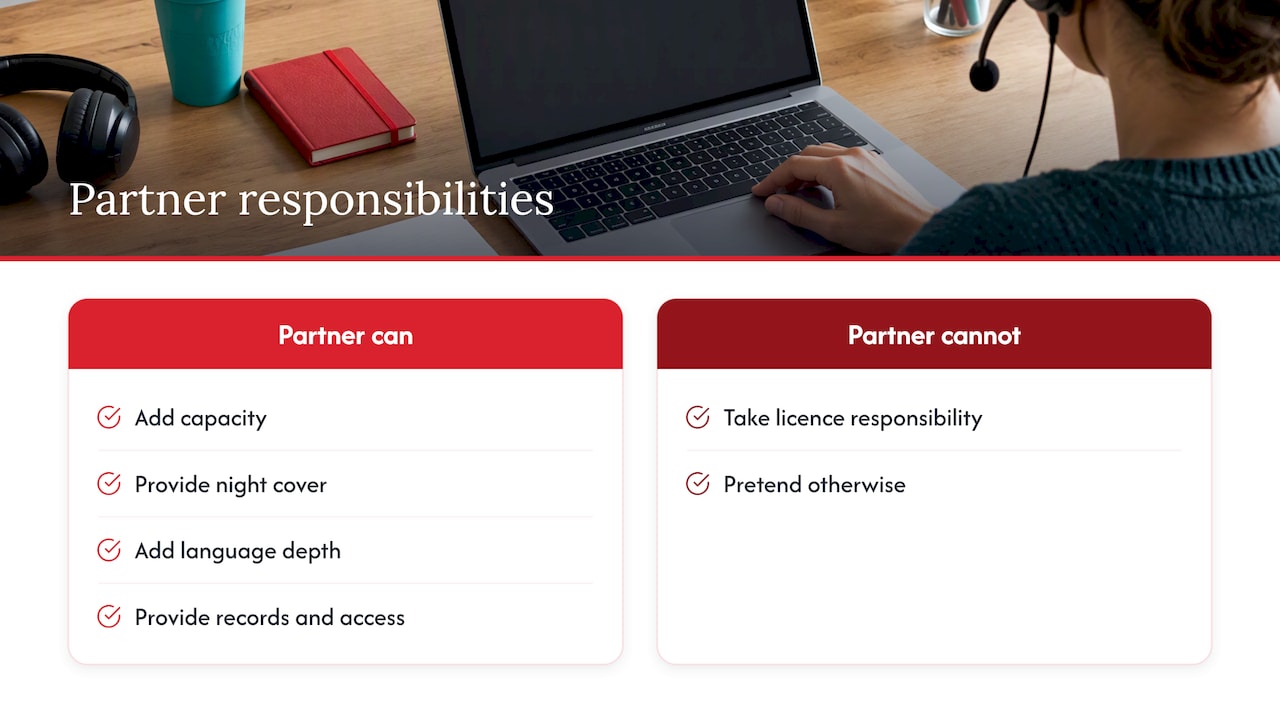
We also say plainly what a partner cannot do. We can add capacity, night cover and language depth. We cannot take on your licence responsibility, and a good partner will not pretend otherwise. It will give you the records and access you need to prove your own compliance.
— Miroslav Maslovarić
What it costs to staff localized queues
Published rates give you a starting point for budgeting. Current rates are listed on our pricing page.
When you model your own scenario, include a team lead per language cluster, second-line capacity for payments, KYC and complaints, and QA time. The cheapest plan on paper is usually the one without those roles.
Launching localized support with Workanova
If you need to add languages or night coverage quickly, we build and run your own named team for iGaming operators, covering live chat, email and ticket support, VIP player support, KYC and payments handling, second-line escalation and QA, all under written SLAs. See how multilingual customer support for iGaming operators works in practice, or talk to us through workanova.com about the languages and markets you need to cover.
FAQ
Is support localization the same as translation?
No. Translation converts text. Localization adapts language, tone, regulatory wording, payment context and escalation rules to a specific market. In regulated gambling, the escalation design usually matters more than the wording of greetings.
Do UK rules require support in every language I market in?
The Commission’s ordinary code on foreign languages says responsible-gambling and help information, player guides and summary contractual terms should be available in each language you market in. It is ordinary code, so departures must be justified and shown to be similarly effective. Check the detail with your compliance lead.
Can I outsource KYC and complaints handling to a support provider?
The Commission’s guidance allows outsourcing providers to be involved in customer due diligence, but the operator remains liable for failures. Your contract should give you immediate access to identity data and records, and name who decides on exceptions. For complaints, keep final-position decisions and ADR referral under your own approved process.
Which languages should I add first?
Start with the languages that generate the most contacts and the most revenue, then add those where your marketing already promises local-language service. Review ticket volume by language each quarter. Add a language only when you can staff it, localize its content and QA it.
How long does it take to launch a new language queue?
The content and playbook work can start immediately, and hiring and training take the longest. We launch dedicated teams in 4 to 8 weeks. Your timeline depends on how ready your terminology, macros and integrations are.
Sources
- LCCP 3.3.2: Foreign languages
- LCCP 3.4.3: Remote customer interaction
- Customer interaction guidance, Requirement 1
- Handling complaints and ADR
- LCCP 6.1.1: Complaints and disputes
- Time limits and escalation of complaints
- LCCP 17.1.1: Customer identity verification
- Reliance on agents and outsourcing providers
- Licensees’ responsibilities for third parties
Recommended