

GAMSTOP Support Process: How Operator Teams Should Handle It
November 20, 2026Promo spike planning is the work of turning a campaign calendar into a support staffing plan before the campaign goes live. You record each promotion as its own window, estimate the extra contacts it will create on top of your normal baseline, convert that into agents per half-hour, and review the forecast against what actually happened. Done well, a free-spins drop or a boosted-odds weekend lands on a prepared team. Done badly, marketing hits send and support finds out from the queue.
This guide is written for Heads of Player Support, CX and Operations at licensed operators. It follows the order in which you would actually run the process, with UK regulatory points placed where they change your decisions.
TL;DR
- Treat every promotion as a dated object with an expected lift, not as noise in your baseline. Marketing and support should share one promo calendar.
- Forecast each channel separately, in half-hour intervals, using past campaigns of the same type as your starting point.
- Convert volume to agents with an Erlang C style calculation, then add shrinkage. Hold a cross-trained reserve for the surge you did not predict.
- In the UK, promotion terms are a support topic too: unclear terms create tickets, and the Gambling Commission expects them to be clear and fair.
- After every campaign, compare forecast to actual and feed the gap back into the next plan.
Table of Contents
- What promo spike planning means for an operator
- Step 1: Record every promotion as a promo window
- Step 2: Estimate the extra contact volume
- Step 3: Turn volume into agents per half-hour
- Step 4: Prepare the floor before the promotion starts
- Step 5: Build UK compliance into the plan
- Step 6: Run it live, then review it
- Our perspective: plan for the failure, not the average
- Where outsourced support fits
- FAQ
- Sources
What promo spike planning means for an operator
In iGaming, demand does not grow in a straight line. Blask’s market analysis makes the case for timing campaigns around identifiable windows such as sports fixtures and cultural events, rather than assuming smooth month-by-month growth. Support demand follows the same shape, because players who are drawn in by a promotion bring questions with them: how do I claim this, why did my bonus not credit, when can I withdraw.
Two details matter for the UK. First, the peaks are not always the ones you expect. G3 Newswire reported that the UK’s three biggest single-day spikes of 2026 were horse-racing days, Grand National Day and the Cheltenham Festival, even though football has out-earned racing in aggregate every year since 2019. Second, the calm between peaks is real. Blask’s January 2026 analysis put mean daily UK market interest at 43.50 million on 1 February 2026, down 15.5% from 51.48 million on 1 December 2025, with the usual spikes from big sporting weekends and promotional surges absent. A flat staffing plan is wrong in both directions: too thin on the peak day, too expensive in the trough.
So the discipline has two halves. One is commercial: know which days will move. The other is operational: know what each of those days costs your support team.
Step 1: Record every promotion as a promo window
The most common cause of a missed forecast is that the promotion never reached the forecaster. Fix that first.
A promo window is a record with fixed fields. At minimum:
- Start and end date and time, including time zone.
- The mechanic: free spins, free bet, deposit match, cashback, boosted odds, jackpot drop, tournament.
- The segment: all players, new registrations, VIPs, a single market or language.
- Channels used to announce it: email, push, SMS, on-site banner, affiliates.
- Expected uplift in registrations, deposits or bets, as supplied by marketing.
- The final terms and conditions, as published to the player.
- An owner on the marketing side who can answer support questions.
The structure is not new. Gamblers Connect describes a promo calendar as a schedule mapping campaigns to dates, segments, verticals, channels, jurisdictions, mechanics, budgets and forecast uplift, with status and audit information. Add one more column that is specific to support: the expected contact drivers. A deposit match generates wagering-status questions. A free-bet offer generates claim failures. A jackpot drop generates payment and verification questions within minutes.
If you already manage a marketing calendar, you can borrow the discipline from content teams. Planning a content calendar works on the same principle: dated entries, owners and a lead time that gives downstream teams room to prepare.
Set a lead-time rule and enforce it. A reasonable rule is that no promotion goes live unless the window is recorded far enough ahead for support to hire, train or reschedule. For routine mechanics that may be a week. For a large event, it is weeks.
Step 2: Estimate the extra contact volume
Start with the baseline, then add the promotion on top. Do not blend the two.
Keep promotions out of your baseline
Promotions make demand non-stationary, which is why simple time-series methods struggle with them. A December 2020 paper in the International Journal of Production Economics explains that static methods may be unsuitable in the presence of promotions, and that baseline forecasts can be adjusted using judgment supported by structured information. In practice: strip past promo days out of the history you use for your everyday baseline, and keep a separate record of what each promotion added.
Build a lift library
For every past campaign, store:
- Contacts per channel in each half-hour, compared with the same weekday and hour in a non-promo week.
- The ratio of promo contacts to baseline contacts (the lift).
- The contact reasons, tagged consistently.
- The number of players who claimed the offer, so you can express contacts per 1,000 claimants.
The last metric is the most portable. Marketing can estimate claimants for a new campaign; you convert that to contacts using the ratio from a similar past mechanic. Scale matters here: the UK Gambling Commission found that 9 in 10 quantitative respondents had received a gambling offer in the previous four weeks, and 76% of recipients used one, with free spins and free bets the most commonly received and used. Offers are normal for your players, so the claim flow must be easy to support.
Forecast by channel, then model the surge
The approach Zendesk recommends for high-demand moments is to analyze history and current trends, include known events, forecast each channel independently, model both expected rises and unexpected surges, and update as new data arrives. Chat and email behave differently under pressure. Chat peaks within minutes of an announcement and drains fast. Email and tickets build more slowly and leave a backlog that can run into the next day. See our comparison of live chat and email support for how the channels differ.
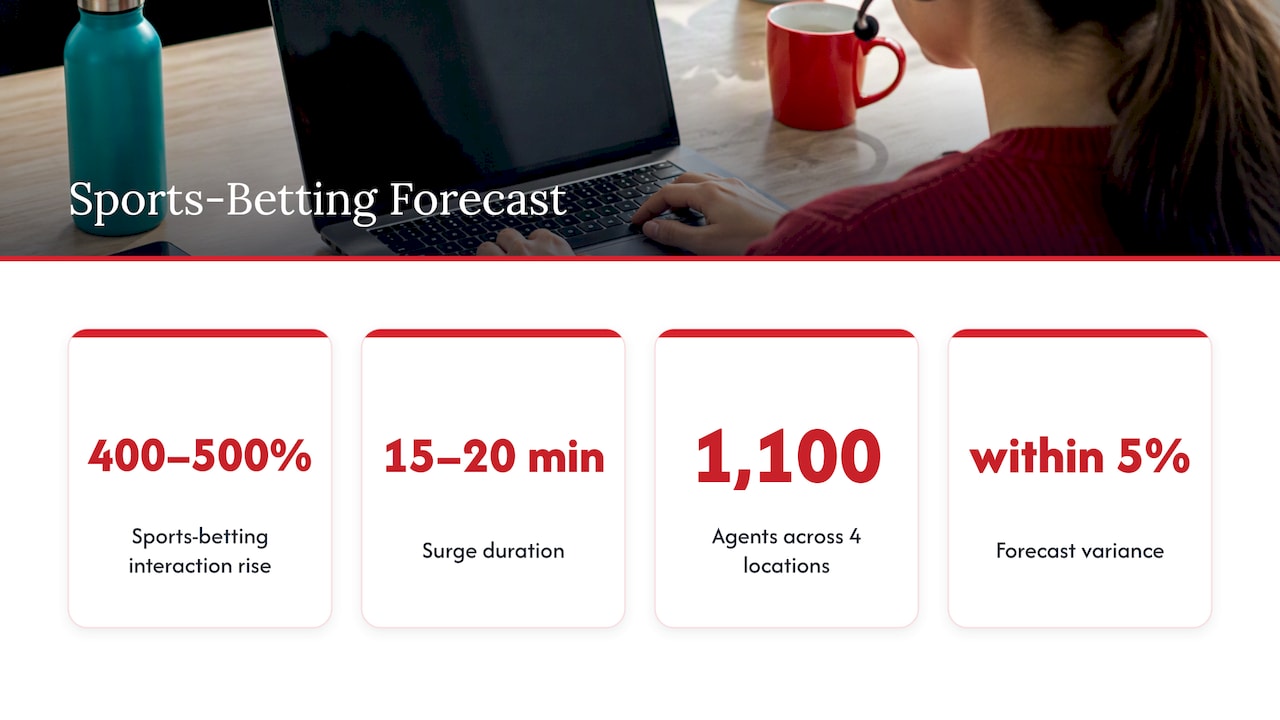
For live betting, the surge can be sharp. A Sabio case study from the UK and Ireland reports sports-betting interactions rising 400 to 500% within minutes and lasting 15 to 20 minutes. The same document reports that the organisation, using 1,100 agents across four locations, achieved forecast variance within 5% after adopting workforce-management technology. Treat those numbers as the shape of the problem: very steep, very short, and forecastable with the right tooling.
What accuracy should you expect without that scale? A 2018 Call Centre Helper survey of UK contact centres found 55.8% of respondents within 10% of actual monthly contact volume, and time spent producing forecasts and what-if scenarios was the most common forecasting problem. Build your model once, keep it simple, and reuse it.
Step 3: Turn volume into agents per half-hour
A forecast of contacts is not a staffing plan. The conversion follows a standard method.
ICMI’s multichannel forecasting toolkit lays out the sequence: set service-level objectives, collect operational and marketing data, forecast volume and handling time for every channel (normally in half-hour periods), calculate base staffing, account for shrinkage, schedule, cost the result, then repeat the model at higher and lower service levels. It names Erlang C, or a variation, as the base formula for developed contact centres, with inputs of average talk time, after-contact work, contact volume and the service-level objective. It also says shrinkage must include breaks, absenteeism, training and other non-contact work, and that staffing is calculated for each half-hour and each distinct agent group.
A worked example
The numbers below are illustrative arithmetic, not client data.
Suppose a baseline Saturday brings 2,000 contacts across channels at an average handling time of 6 minutes. That is 200 hours of handling work. A promo window lifts the day by 50%, to 3,000 contacts, or 300 hours.
- Target occupancy of 85%: 300 ÷ 0.85 is about 353 productive hours needed.
- Shrinkage of 30%: 353 ÷ 0.70 is about 504 paid hours.
- The same calculation for the baseline day gives about 336 paid hours.
The promotion adds roughly 168 paid hours, the equivalent of 21 eight-hour shifts, and that is before you allow for the fact that the extra volume is concentrated in a few half-hours rather than spread evenly. Run the calculation per interval, not per day, or you will staff the average and miss the peak.
Run it at two or three service levels and show the cost of each to the person who approves the budget. The trade-off is then a decision, not a surprise.
Step 4: Prepare the floor before the promotion starts
Forecasting only helps if the capacity exists on the day. Zendesk’s guidance lists adaptable schedules, split shifts, staggered breaks and a reserve pool of cross-trained agents, plus an updated knowledge base, proactive communication and automation for routine tasks. Here is how that translates into a checklist.
- Shift design. Put start times where the half-hour forecast says the load is. Split shifts and staggered breaks keep coverage through the announcement and the first hour after it.
- Reserve pool. Train agents from other queues on the promo mechanic so they can be moved in. Cross-training is cheaper than overtime and works faster than hiring.
- Knowledge base. Publish the promotion’s terms, eligibility rules, known issues and approved macros before launch, not after the first wave of tickets.
- Proactive communication. If a claim step is confusing, a clearer banner or confirmation message removes contacts at source. The igaming.cx article on bonus tickets suggests tracking the share of tickets that are bonus-related and the claim-failure rate by offer, which tells you which offers to fix.
- Escalation paths. Agree who handles payment, KYC and technical issues during the window, and make sure second-line staff are on shift when the peak is expected. Verification and withdrawal questions often spike alongside deposits.
- Automation decisions. Decide in advance which contacts a bot or self-service flow handles, such as wagering status, and which go straight to a person, such as complaints and vulnerable-player signals.
If you are weighing a new delivery location for permanent capacity, the requirements of call center setup in Portugal show how long employment, onboarding and compliance steps take in a single country, which is a useful yardstick against your own hiring timeline.
Step 5: Build UK compliance into the plan
For a UK-licensed operator, promotion support is not only a volume question. Terms that confuse players produce contacts, complaints and regulatory exposure at the same time.
- Clear terms. The Gambling Commission’s marketing code requires incentive terms to be clear, transparent, fair and readily accessible to any customer or prospective customer to whom the incentive is offered. Its LCCP condition 5.1.1 applies to all licences except gaming-machine technical and gambling-software licences, and caps wagering requirements at 10 times.
- Visible conditions. Its open and transparent marketing guidance says significant conditions must be prominent and close to the headline offer, and remain available for the full promotion. Agents should be able to point to the exact wording the player saw.
- Evidence of fairness. In its 16 February 2022 fair-terms update, the Commission told licensees to review promotions, especially welcome bonuses and wagering requirements, and said operators must be able to evidence fairness and transparency. Your promo window record, with its final terms, is that evidence.
- Harm indicators. The Commission’s customer interaction guidance, issued in August 2023 and in effect from 31 October 2023, requires licensees to stop direct and targeted marketing and uptake of new bonus offers as soon as practicable where strong indicators of harm are identified. Support agents are often the first to see those indicators, so your escalation route to the safer gambling team must work during a surge as well as on a quiet Tuesday.
- High-value players. The industry guidance on high-value customers from September 2020 says licensees should not time incentives to excessive play or significant losses, nor incentivise chasing losses, and should restrict or end personalised incentives when play exceeds usual habits without explanation. VIP promotions need a second pair of eyes before launch.
Withdrawals and complaints also set deadlines for your plan. The Commission said in its July 2023 blog on withdrawals that withdrawal problems were still the number-one issue raised with its Contact Centre, and that data from some large gambling companies showed about 99% of withdrawals processed within 24 to 48 hours. A promo-driven deposit wave becomes a withdrawal wave a day or two later, so schedule payments staff for the second peak. For complaints, the Commission’s time-limits guidance says an operator offering 24-hour gambling should acknowledge complaints within 24 hours, and the overall process must normally finish within eight weeks, subject to the stated stop-the-clock exception. A surge week cannot become a reason to miss that acknowledgment.
Step 6: Run it live, then review it
During the window, watch four measures. Zendesk names service level, occupancy, average handling time and backlog age as the real-time measures for adjusting staffing, reprioritising work and redistributing capacity. Set thresholds in advance. For example: if service level falls below target for two consecutive intervals, move reserve agents into chat; if backlog age on email passes your limit, pause low-priority work.
The forecast is not fixed once the promotion opens. Compare actual to forecast every hour for the first day and adjust the remaining intervals. A forecast that lands 30% low at 18:00 will usually be 30% low at 20:00.
After the window closes, run the review within a week while the detail is fresh:
- Forecast vs actual contacts per channel and per half-hour. Record the percentage error.
- Service level, abandonment and backlog age at the peak intervals.
- Contact reasons. The igaming.cx article suggests tracking bonus-ticket share, claim-failure rate by offer, wagering-status contacts per active bonus, goodwill-request rate, and ticket reopen or channel-switch rate. Together they show whether the offer design, not just the staffing, caused the load.
- Customer effort. The UK Contact Centre Forum’s 2025 performance review highlights customer-effort measurement as a current challenge alongside CSAT and NPS. A promotion that is cheap to run but hard to claim shows up here.
- Update the lift library with the new ratios, and write down one change for the next campaign.
Our perspective: plan for the failure, not the average
We run dedicated player support teams for licensed operators, and the pattern we see is consistent. Operators rarely fail because the forecast was slightly off. They fail because the forecast arrived after the decision to launch, or because the team that needed to staff up could not do it in the time left.
Three views follow from that.
First, the promo calendar is a support document. If support is not on the distribution list, the plan is already late. We ask clients to share dated promotions with us as early as they share them with their affiliates.
Second, lead time is the real constraint. Hiring, training and equipping agents takes weeks. Our own deployments take 4 to 8 weeks for a named dedicated team, and that is a fast timeline. Recruiting a surge team from nothing the week before a jackpot drop or a major sporting event is not a plan. A standing team with a trained reserve is.
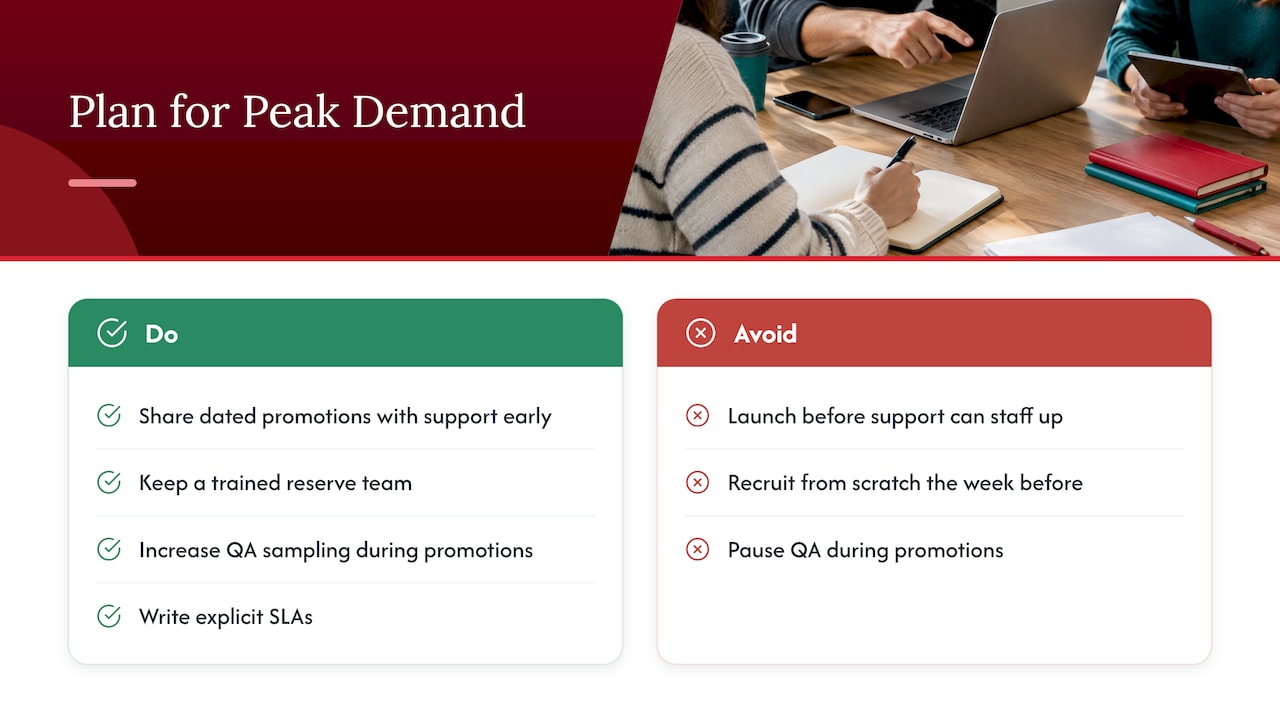
Third, the quality of the first answer matters more during a peak than at any other time. When ticket volume multiplies, a wrong answer on bonus terms comes back as a second and third contact. QA sampling should increase during a promotion, not pause for it. Written SLAs make that accountability explicit for both sides.
The practical test we suggest: pick your next three promotions and ask whether support could handle double the expected volume with the staff already trained. If the answer is no, the gap is your planning priority.
— Miroslav Maslovarić
Where outsourced support fits
We build and run dedicated, named player support teams for licensed iGaming operators: 24/7 live chat, email and ticketing, VIP and retention support, KYC and payments handling, second-line escalation and QA, in 14+ languages and under written SLAs. Teams are live in 4 to 8 weeks, which means you can put capacity in place ahead of a major event rather than after it.
Current rates are listed on our pricing page. See the pricing page for the details, or read how we approach scaling player support without adding risk and preparing for a traffic surge. If you want a plan for your next campaign, talk to our iGaming support team.
FAQ
How far ahead should support know about a promotion?
As early as marketing does, and no later than your lead-time rule allows. For a routine mechanic, a week may be enough to adjust schedules and brief agents. For a large event or a new offer type, you need weeks, because hiring and training are the slow steps.
What is the best way to estimate contacts from a new type of promotion?
Use the closest past mechanic and express its contacts per 1,000 claimants, then apply marketing’s claimant estimate. Model a low, expected and high case, and staff to the expected case with a cross-trained reserve covering the high case. Update the forecast hourly once the promotion opens.
Should promotion volume go into the baseline forecast?
No. Promotions make demand non-stationary, so keep them as separate dated windows with their own lift. Adding them to the baseline inflates quiet-day staffing and still under-forecasts the next campaign.
Do UK rules affect how support handles promotions?
Yes. Incentive terms must be clear, transparent, fair and readily accessible, and operators must be able to evidence this. Agents need the exact published terms, and a route to escalate harm indicators to your safer gambling team during the surge.
Sources
- Why iGaming markets don’t grow in straight lines
- Where does iGaming demand go during a World Cup?
- UK iGaming January 2026 market decline analysis
- What Is a Promo Calendar in iGaming?
- Demand forecasting in the presence of systematic events
- Exploring consumer journeys using gambling promotional offers
- iGaming customer support strategies for high-demand moments
- Sabio UK sports betting case study
- Call Centre Helper 2018 Survey Report
- ICMI multichannel forecasting toolkit
- How to Cut Bonus Support Tickets Without Killing Conversion
- Gambling Commission: Codes of practice, 5 Marketing
- LCCP Condition 5.1.1
- Open and transparent marketing
- Gambling Commission updates guidance on fair terms and practices
- Customer interaction guidance, requirement 10
- High Value Customers: Industry Guidance
- Exploring the topic of withdrawing funds from accounts
- Complaints and disputes: time limits and escalation
- UK Contact Centre Performance Review 2025
- How to plan a content calendar
- Portugal call center setup
Recommended