
Rapid Support Team Setup for iGaming Operators
November 19, 2026A GAMSTOP support process is the set of steps your agents follow when a player asks about self-exclusion, reports a block that does not look right, or asks to be let back in. For a UK-licensed operator it needs three things: a fast route for players who want to exclude, a firm no-reversal rule during the active period, and a warm handover to specialist help. This guide sets out the rules your process rests on, a step-by-step workflow, the scripts and escalation paths agents need, and the QA checks that keep it compliant.
TL;DR
- GAMSTOP is free, and since 31 March 2020 every operator licensed by the Gambling Commission must be part of it as a licence condition.
- Players who ask to self-exclude should be able to do so immediately and be offered the chance to speak to someone appropriate.
- Support cannot reverse an active exclusion on request. Exclusions also do not lift automatically at expiry: the player must request removal with GAMSTOP.
- Write the process down as an SOP, train every language team on it, and score it in QA like any other compliance contact.
- Peak events raise the volume of these contacts, so plan staffing for them in advance.
Table of Contents
- What GAMSTOP covers, and what your agents must know
- The contacts your team will actually receive
- A step-by-step GAMSTOP support process
- When a player asks to be let back in
- When the exclusion period ends
- Signposting support, not just the scheme
- Who owns it: roles and escalation
- What QA should check
- Peak events and night shifts
- Our perspective
- How Workanova can help
- FAQ
- Sources
What GAMSTOP covers, and what your agents must know
GAMSTOP is a free self-exclusion service for people living in Great Britain and Northern Ireland. It lets them exclude themselves from all licensed gambling websites and apps, for at least six months, with options of one year, five years, or five years with auto-renewal.
The regulatory position is clear. All businesses licensed to offer remote gambling to individuals in Great Britain must implement self-exclusion procedures and take all reasonable steps to refuse service to excluded people. Since 31 March 2020 GAMSTOP participation has been a licence condition. The Gambling Commission also describes the scheme as a way to exclude from all online gambling for at least six months.
Your agents do not need to be GAMSTOP experts, but they need a short, accurate fact sheet for the questions that come up most:
- How the block works. GAMSTOP compares the details a person registered with against the details they give a gambling company. Every licensed online operator must check with GAMSTOP when someone registers or logs in, and operators holding an account must also check excluded status daily.
- Timing. Registration takes a few minutes, but it can take up to 24 hours for the block to become effective.
- Money. Registering does not automatically return withdrawable funds, so the player must contact each operator where they hold an account.
- Identity checks. Registration asks for title, name, date of birth, email, mobile number and postal address, and may include identity verification through a third-party provider.
- Limits. GAMSTOP’s own terms say the service is an aid, is not foolproof, and works best when people do not try to work around it.
That last point matters for tone. Agents describe GAMSTOP accurately, as one tool among several, and never promise that it guarantees anything.
The contacts your team will actually receive
Most GAMSTOP-related tickets fall into a small number of types. Sorting them at intake is the first step to handling them consistently.
| Contact type | What the player says | Agent action |
|---|---|---|
| Wants to exclude | “I want to stop gambling with you” or “How do I self-exclude?” | Act at once, explain the operator’s own tools and GAMSTOP, offer to speak to someone appropriate, do not delay |
| Registered, still sees the account | “I joined GAMSTOP but can still log in” | Explain the up-to-24-hour window, check the account status, escalate if the account is still active after that |
| Registration problems | “GAMSTOP will not let me finish signing up” | Signpost to GAMSTOP directly, because they advise contacting them if you have difficulty registering |
| Funds | “Where is my balance?” | Explain account closure and return of funds through the operator’s normal verified process |
| Wants back in during the period | “I have changed my mind, please reopen my account” | Decline, explain kindly, signpost to support, log the contact |
| Period has ended | “My exclusion is over, why am I still blocked?” | Explain the removal request that GAMSTOP requires and give GAMSTOP’s contact details |
| Distress or harm | Mentions of debt, loss of control, family harm | Move to the safer gambling route immediately, give helpline details |
A step-by-step GAMSTOP support process
This is the workflow we recommend operators write into their SOP. Adapt the details to your platform, your licence conditions and your safer gambling policy.
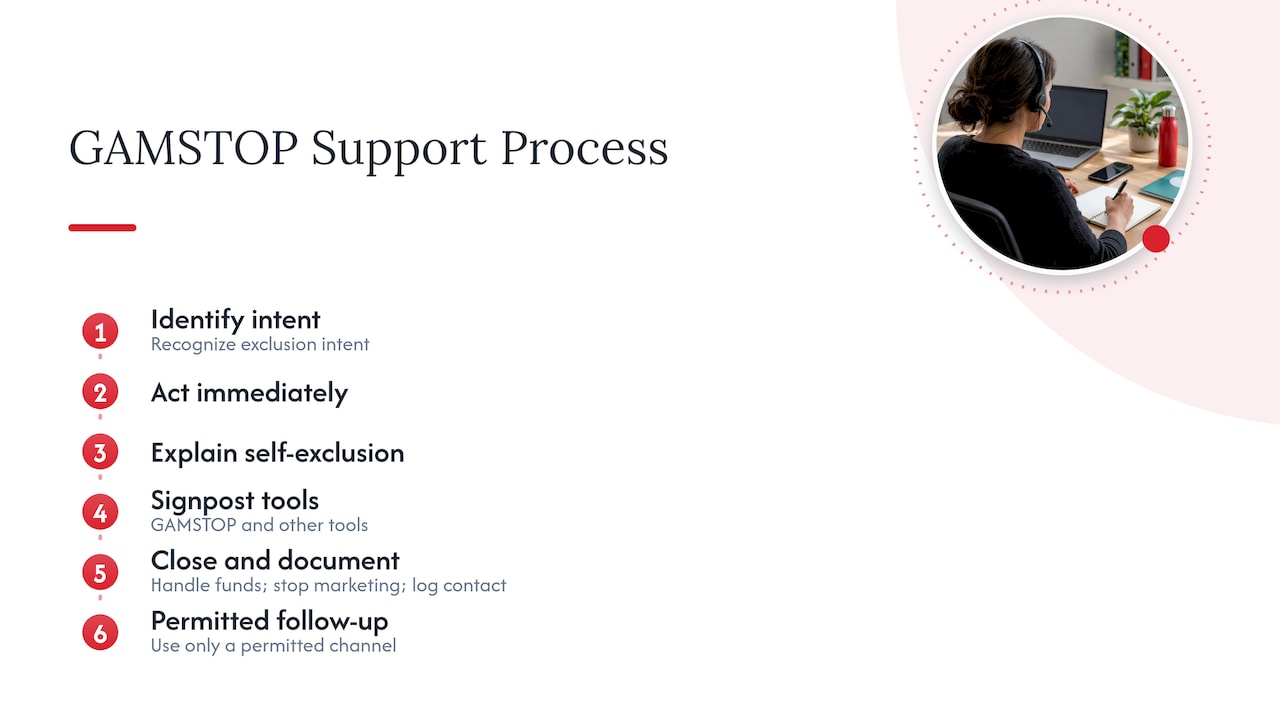
1. Identify the intent in the first reply
Train agents and chatbot routing to recognise exclusion language early: self-exclude, GAMSTOP, block me, close my account, I cannot stop. Tag the ticket with a dedicated category so it never sits in the general queue. A player who has just decided to exclude should not wait behind promo questions.
2. Act immediately on a request to exclude
The Commission’s guidance for operators is that customers who decide to self-exclude should be able to do so immediately, without waiting, and be offered the opportunity to speak with someone appropriate. In practice: the agent confirms the request, applies your internal exclusion or hands to the team that does, and does not try to retain the customer with offers, bonuses or persuasion.
3. Explain what self-exclusion means
Operators should make sure players understand the exclusion as a commitment not to attempt to gamble for a minimum of six months. Keep the explanation short and neutral. Cover the length options, that it applies across licensed operators when done through GAMSTOP, and that it cannot be cut short.
4. Point to GAMSTOP and to other tools
GAMSTOP covers licensed online operators, but it works better alongside other measures. GAMSTOP’s own support page lists bank blocks, blocking software including the free Gamban and BetBlocker, and the National Gambling Helpline. The Gambling Commission likewise says that people should seek support in addition to self-exclusion. Your agent should name these in the reply, not just link to a generic page.
5. Close the account and handle funds
The Gambling Commission states that the business must close the account, return any money in it, and remove the person’s details from marketing databases. Support’s role is to trigger these actions and tell the player what happens next. Where KYC or payment checks stand between a player and their balance, hand the case to a trained specialist and keep the player informed. See our guide to the KYC verification process for how that handover should work.
6. Stop marketing and log the contact
After exclusion, confirm that CRM, email, SMS and affiliate-driven messaging have stopped. Log the contact, the time, the action taken and who took it. This audit trail is what you show a regulator or internal compliance if a case is questioned.
7. Follow up through the right channel
Only send follow-up that the player has agreed to and that is permitted for excluded customers. A short confirmation of the action taken is reasonable. Anything that looks like winning the player back is not.
When a player asks to be let back in
This is the hardest contact for agents, because the player is often polite, persuasive and upset. The rule has to be simple: an active exclusion is not reversed on request.
GAMSTOP is explicit that you cannot remove your exclusion before the minimum period ends. The Gambling Commission describes self-exclusion as a formal agreement not to gamble, during which the business must take reasonable steps to stop the person gambling.
A workable script structure:
- Acknowledge the request without judgement.
- State clearly that the exclusion cannot be lifted while it is active.
- Explain that this is the purpose of the commitment, not a penalty.
- Offer the helpline and other tools.
- Escalate to your safer gambling lead if the player seems at risk.
Do not give agents discretion here. Discretion is where inconsistent outcomes and compliance failures come from. Give them wording, and make it clear who they escalate to.
When the exclusion period ends
Players often assume the block disappears on the expiry date. It does not. The exclusion stays in place for up to a further seven years unless the person signs in, confirms it has expired and requests removal, via online chat or by phone on 0800 138 6518 (daily, 10am to 8pm, per GAMSTOP’s page at the time of writing).
Your agent cannot do this for the player. What they can do is give the correct information, so the player is not bounced between you and GAMSTOP. Add a macro that says what the player must do, who to contact and that your team cannot lift the block on their behalf. Check the details against GAMSTOP’s page at least quarterly, because contact hours and numbers can change.
If you also run your own operator-level exclusions, keep them separate in your scripts. A player may be out of GAMSTOP and still within an exclusion you applied, and the agent needs to know which one they are discussing.
Signposting support, not just the scheme
GAMSTOP is a tool, not a support service. When a player is struggling, the most useful thing your agent can do is connect them to people. The National Gambling Helpline, run by GamCare, is free, confidential and open 24 hours a day on 0808 80 20 133, with live chat available.
GamCare also suggests practical steps for people who are struggling: blocking gambling sites, tracking spend, setting a budget and seeking debt advice. Agents should not play counsellor. They should give the number, say it is free, and let the player decide.
A short, tested reply template beats an improvised one. Write it in each language your team supports, and check it for tone, not just accuracy.
Who owns it: roles and escalation
A GAMSTOP process breaks down where nobody owns the handover. Define the roles before launch.
- First line: recognises intent, applies the scripted response, tags and escalates.
- Safer gambling or compliance lead: owns the policy, the scripts and any exception judgement.
- Payments and KYC: handle returns of funds and verification holds.
- Second line: takes the cases first line cannot close, such as a player still active after the 24-hour window, a dispute about an account opened with different details, or a complaint.
- QA: samples these contacts every week, not just when something goes wrong.
Second-line staff need more experience and more authority to investigate. Current rates are listed on our pricing page.
What QA should check
Score GAMSTOP contacts on a dedicated scorecard. Useful checks:
- Was the intent recognised in the first reply?
- Was the exclusion actioned without delay or retention attempts?
- Did the agent describe GAMSTOP accurately, without promising guarantees?
- Was the 24-hour window mentioned where relevant?
- Were the helpline and blocking tools offered?
- Was the contact logged with the right category?
- Was escalation used when the player showed signs of harm?
Review a higher share of these contacts than of ordinary tickets. Calibrate scorers across languages so a German or Swedish reply is judged against the same standard as an English one. For a wider framework, see our iGaming player support standards and SOP playbook and our guide to compliance-focused player support.
Peak events and night shifts
A jackpot drop, a major tournament or a heavy promo week raises ticket volume, and with it the number of players who realise they have gambled more than they intended. These are the moments when exclusion requests rise and when a stretched team is most likely to be slow or curt. A request to exclude that sits unanswered overnight is the failure your process exists to prevent.
Plan for it: keep exclusion requests in a priority queue, make sure the night shift has the same scripts and escalation contacts as the day shift, and brief every language team before the event. Our notes on World Cup support coverage cover how we think about staffing for these windows.
Our perspective
We see the GAMSTOP contact as the clearest test of a player support team. Speed is not enough, and neither is politeness. The player needs an immediate action, an accurate explanation and a way to reach real help.
Our view is that this works best as a written process owned by a dedicated team, not as improvisation by whoever is on shift. That is how we build player support teams for licensed operators: named agents, trained on the operator’s own SOPs, covering 24/7 in 14+ languages, with second-line escalation and QA running alongside, and written SLAs on top.
When volumes spike, the quality of these contacts should not depend on how many people happen to be online. A trained team, briefed in advance, protects players and protects your licence.
Miroslav Maslovarić
How Workanova can help
We build and run dedicated outsourced player support teams for licensed iGaming operators, launched in 4 to 8 weeks. That includes live chat, email and ticketing, KYC and payments handling, VIP support, second-line escalation and QA, all under written SLAs. Your GAMSTOP and safer gambling scripts become part of the team’s training from day one.
Current rates are listed on our pricing page. If you want a team that handles exclusion contacts to your standard, talk to us about 24/7 iGaming player support.
FAQ
Can player support remove a GAMSTOP exclusion?
No. Operators cannot lift an exclusion placed through GAMSTOP, and GAMSTOP will not remove it before it has expired. After expiry the player must request removal with GAMSTOP directly. Your agent’s role is to give the correct information and signpost.
How long until a GAMSTOP registration takes effect?
Registration takes a few minutes, but the block can take up to 24 hours to become effective. If a player can still access an account after that window, treat it as an escalation and check the account status and the details held on file.
What should an agent say to a player who wants to self-exclude?
Act immediately, without retention offers. Explain that the commitment lasts a minimum of six months, describe the GAMSTOP options, and offer the chance to speak to someone appropriate. Then give the National Gambling Helpline number, 0808 80 20 133.
Does GAMSTOP cover every gambling account?
It covers online gambling companies licensed in Great Britain. Once registered, a person is blocked from gambling with all of them for the chosen period. It is not foolproof, so agents should present it alongside blocking software, bank blocks and support.
Why is a player still blocked after the exclusion period ended?
The exclusion does not lift on its own. It remains for a further seven years unless the player signs in and requests removal. Direct them to GAMSTOP’s chat or phone line.
Sources
- What is Gamstop Online? (GAMSTOP)
- Making those at risk safer online (Gambling Commission)
- Terms of Use (GAMSTOP)
- How does Gamstop Online work? (GAMSTOP)
- Register (GAMSTOP)
- What do I need to register with Gamstop Online? (GAMSTOP)
- Self-exclusion in social responsibility (Gambling Commission)
- Self-exclusion (Gambling Commission)
- Tools and support (GAMSTOP)
- My exclusion has expired. How do I remove it? (GAMSTOP)
- Safer gambling (GamCare)
- Five things you can do if you’re struggling with gambling (GamCare)
Recommended