Sportsbook Peak Season Planning: A Support Playbook for UK Operators
November 9, 2026Non-voice support channels are every way a player can reach you in writing instead of on a call: live chat, email and ticketing, messaging apps and social media. For most licensed operators, live chat should carry the in-session load, email and tickets should carry anything that needs documents or a written record, and messaging apps and social should be added only once your systems can keep a single player history across them. This guide shows what each channel is for, where the UK rules bite, how to measure it and how to staff it when volume spikes.
TL;DR
- Live chat is for in-session issues such as bets, bonuses, cash-out and game errors. Email and tickets are for KYC documents, source-of-funds and formal complaints.
- Add messaging apps and social channels only after your helpdesk is connected to your PAM, payments and KYC data.
- UK licence holders need a clear written complaints process, and chat agents must be trained to spot complaints and redirect them.
- Measure First Contact Resolution and repeat contact rate before handling time.
- Peaks (jackpots, major sporting events, promos) break non-voice queues first, so plan staffing before the event, not during it.
Table of Contents
- What non-voice support means for an operator
- The main non-voice channels compared
- Which issue goes to which channel
- UK compliance points for written channels
- How to build a channel mix that holds together
- Measuring non-voice performance
- Staffing non-voice channels for peaks
- Our perspective
- A managed non-voice team from Workanova
- FAQ
- Sources
What non-voice support means for an operator
In a general call-center context, non-voice means any support that does not involve a real-time spoken exchange. In iGaming the definition is narrower and more demanding. Your agents are handling money, identity checks and, often, players who are upset or at risk. Operators commonly rely on live chat, email and self-service, and social and public channels are where dissatisfied customers may escalate when they feel unheard.
That last point matters for planning. A slow chat queue does not stay private. It turns into a public post, a regulator complaint or a chargeback. Treat every non-voice channel as part of one operation, not as separate inboxes.
The main non-voice channels compared
The table summarizes how the channels differ in practice. The detail follows below.
| Channel | Best for | Weak spot | Typical owner |
|---|---|---|---|
| Live chat | In-session issues: bets, bonuses, cash-out, game errors | Needs enough concurrent agents at peak | Frontline agents |
| Documents, source-of-funds, written complaints, ADR packs | Unsuitable for urgent issues | Frontline plus specialist teams | |
| Ticketing | Cases that need ownership, an audit trail and handoffs | Needs good categories and routing | Frontline, second line, QA |
| Messaging apps | Mobile follow-up, VIP contact, status updates | Context is lost if not linked to the player account | VIP and retention agents |
| Social media | Public reputation and escalations | Visible to everyone | Senior agents, team leads |
Live chat
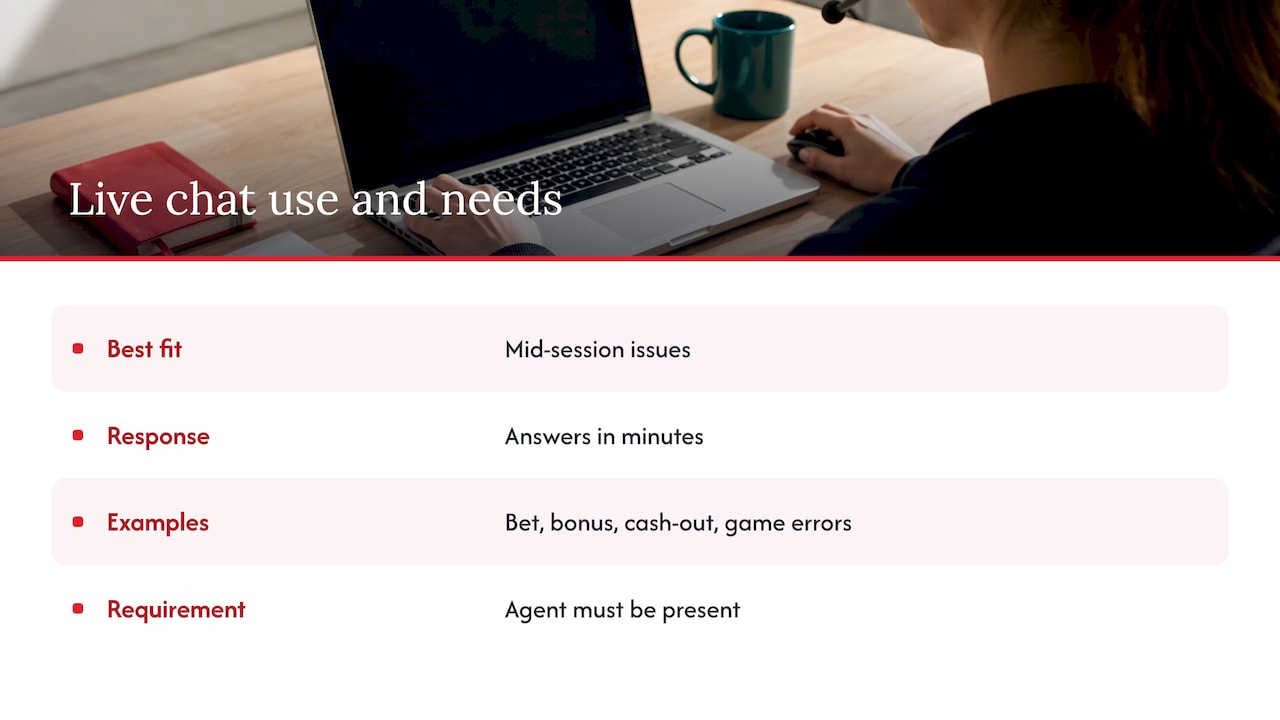
Live chat is the main channel at many online operators because it matches the immediacy players expect. It works best where the player is mid-session and needs an answer in minutes: a bet that did not settle, a bonus that did not credit, a cash-out question or a game error. Live chat suits in-session issues precisely because the agent can look at the account while the player waits.
It has one hard requirement: someone must be there. A chat widget with no agent behind it at 3 a.m. does more damage than no widget. If you want to see how your own offer looks from the player side, our five-minute 24/7 live chat test is a quick check. For a deeper view on the trade-offs, see our comparison of live chat and email for iGaming.
Email and ticketing
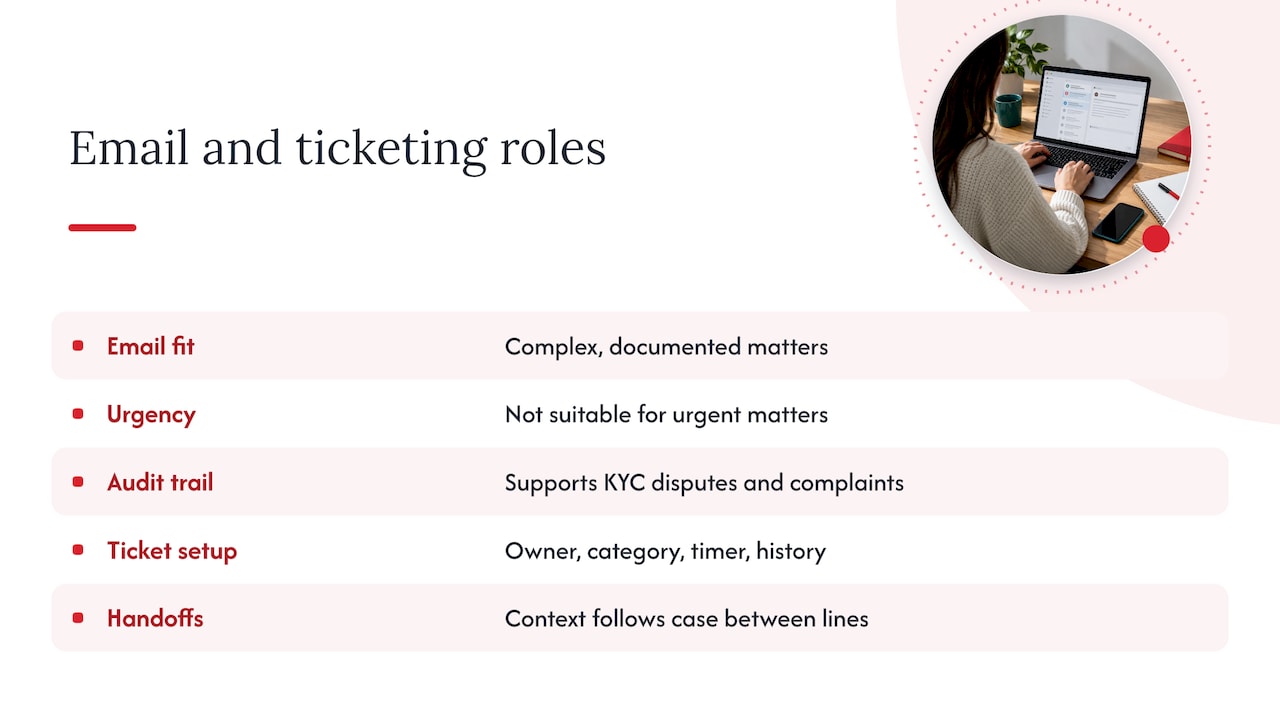
Email is the right channel for matters that need documentation, investigation or a considered reply. It is suitable for complex matters and unsuitable for urgent ones. In practice that means documents, source-of-funds, written complaints and the packs that go to an alternative dispute resolution (ADR) body. Email suits those cases, and it also gives you the written audit trail that KYC disputes and complaints need.
Ticketing is what keeps email from becoming a shared inbox. Each case gets an owner, a category, a timer and a history. When a case moves from first to second line, the ticket carries the context so the player does not repeat themselves. If you are deciding whether to build this yourself, read why operators choose managed ticketing over an in-house setup.
Messaging apps
WhatsApp, Viber and Telegram can serve players who are already on their phones and do not want to open the casino site again. They also let players send screenshots, clips and voice notes from an app they already use. That helps with game errors and payment proofs. They suit mobile follow-up, VIP contact and status updates.
The condition is data. A messaging thread that is not linked to the player account is a compliance and quality risk, because the agent cannot see the history and you cannot show the record later. Which brings us to the channel mix.
Social media
Treat social as an escalation and reputation channel, not a primary desk. Move the conversation into a private, logged channel quickly, and give these replies to senior agents or team leads who know what can and cannot be said publicly about a player’s account.
Which issue goes to which channel
A simple routing rule helps agents and players alike:
- The player is playing now and needs an answer in minutes: live chat.
- The case needs documents or proof: email or a ticket. KYC uploads, account verification disputes and source-of-funds responses belong in a channel with a written audit trail.
- The player is unhappy and wants a formal response: treat it as a complaint and move it into the written complaints procedure.
- The case is high-risk or specialist: pass it to second line. Industry experts describe tiered operations in which frontline agents handle routine queries, while specialist teams such as Payments, Fraud and Safer Gambling manage complex or high-risk matters.
- The player is a VIP: route to a named contact on the player’s preferred channel, usually a messaging app or direct email.
When should a case move to voice? Where you offer a phone line, do it when text has failed twice, when the player is distressed, or when a safer-gambling concern needs a human conversation. Write that trigger into your playbook so agents are not guessing.
UK compliance points for written channels
If you hold a UK Gambling Commission licence, your non-voice channels are regulated touchpoints, not just service tools. Four points to build in:
- A plain-English complaints process. The Commission’s guidance says licence holders should put into effect a clear, written complaints process in plain English that is simple to understand and easy to find and use.
- Accepting complaints through the channels you run. The same guidance expects licence holders to accept complaints made in person, spoken or written, over the telephone or by email where facilities exist, or through third-party intermediaries and support tools such as Resolver.
- Chat agents who recognize complaints. When live chat is offered, staff should be trained to recognize complaints and redirect them to the formal procedure. A frustrated chat that is closed as an ordinary contact is a compliance gap.
- Careful handling of account holds. In the UK, systems must tell agents that an account is subject to a hold and what may be said, without exposing details they must not disclose.
Enforcement shows why this is not theoretical. The Commission found that four PPB licensees failed to comply with paragraphs of SRCP 3.4.3 relating to remote customer interaction, and they agreed a payment in lieu of a financial penalty of £2,000,000. Have your compliance lead review scripts, macros and escalation rules for every channel, and confirm the current licence conditions on the Commission’s site.
How to build a channel mix that holds together
More channels is not the goal. A mix you can staff, trace and audit is. Follow this order:
- Map today’s entry points. List every place a player can reach you: widget, email address, app, social handles, in-app forms.
- Unify them in one helpdesk. It should connect to your PAM, payments and KYC systems. Add new channels only after integrations and transcripts are in place.
- Give agents one conversation layer. An agent should see the player’s full history across channels, including PAM data, payments and earlier tickets, so service is not fragmented.
- Set rules per channel. Define first-response targets, who owns what, and when a case moves to second line.
- Review the mix regularly. The right mix is not static. It has to shift with request volumes, staffing capacity and the urgency of the issues players bring.
The principle behind step 2 and 3 is the same one described in guidance on omnichannel customer experience: connect touchpoints and customer data so each interaction continues the last one instead of starting over. Bringing a connected view into support also supports retention work, since an omnichannel setup gives a fuller picture of each player.
One operator example points the same way. Bally’s Interactive moved its support structure toward more messaging traffic than email, and Zendesk reports a measurable drop in monthly users contacting support. That is a vendor case study, so treat it as one data point, not a promise for your own operation.
Measuring non-voice performance
Handling time is easy to report and easy to game. Pressure to reduce average handling time can encourage agents to close contacts rather than resolve them. Better measures:
- First Contact Resolution (FCR). It shows whether the player had to come back. It is a considerably better indicator than handling time.
- Repeat contact rate. The inverse view of FCR, and quick to pull from your ticketing data.
- First response and wait times. These matter most on live chat. One 2026 study of nine crypto casino operators found median first-response times of 1 minute 30 seconds for live chat and 2 hours for email. The sample is small and specific to crypto casinos, so use it as a rough reference, then set targets from your own data.
- QA scores. A reviewer scores a sample of chats and emails against a checklist that includes compliance behaviors: complaint recognition, correct handling of holds, no disclosure of restricted details.
For the full metric set and how it ties to revenue, see our guide to CSAT, FCR and AHT.
Staffing non-voice channels for peaks
Non-voice queues fail at the moments that matter most. A jackpot drop, a major sporting event or a promo push multiplies chat and ticket volume within minutes, and email backlogs grow overnight. Internal teams rarely hire and train fast enough once the date is known.
A practical peak plan:
- Forecast by channel. Estimate chat concurrency and ticket inflow separately, using your last comparable event.
- Split queues. Keep payments and KYC cases out of the general chat queue so they cannot block quick answers.
- Prepare macros and status messages. Pre-approved, compliant replies for known issues cut handling time without cutting corners.
- Cover the night shift. Peaks do not respect office hours, and overnight is where small teams run thin.
- Hold a second-line reserve. Complex cases surge with volume, so escalations need capacity too.
If you cannot staff this internally, a dedicated outsourced team is the usual answer. Our guide to setting up an outsourced support team in four weeks walks through the launch steps.
Our perspective
We run non-voice support for licensed operators every day, and the same pattern repeats. Operators add channels faster than they add the systems and people behind them. The result is a widget with slow answers, an inbox with no owner and a complaints trail nobody can reconstruct.
Our view is simple: pick fewer channels, staff them properly and connect them to the player record. Live chat and email and ticketing are the core. VIP contact and second line sit on top. QA ties it together, because a channel without review drifts.
We build dedicated, named teams for operators, hired, trained and equipped for your brand, and we aim to launch them in 4 to 8 weeks. Coverage is 24/7 in 14+ languages and backed by written SLAs. We are designed for the peaks, such as jackpots, World Cup and major sporting events, and promo spikes, when ticket volume multiplies and an in-house team cannot grow in time.
If you take one thing from this article, take this: the right channel mix is the one you can staff at your worst hour, not your average one.
Miroslav Maslovarić
A managed non-voice team from Workanova
We are a Belgrade-based BPO working in EU time zones, and we run player support for online casinos and sportsbooks: live chat, email and ticket support, VIP player support, KYC and payments handling, second-line escalation and QA.
Published pricing starts at €7.15 per hour for a Customer Support Agent and €16.95 per hour for a Manager/Team Lead, plus a Workanova fee from €400 per month per seat. Second-line support is listed at €1,800 to €3,200 per month per agent. See the pricing page for details, or use the support cost calculator to model your own volume. When you are ready to talk about a team for your brand, start at workanova.com.
FAQ
What does non-voice chat support mean?
It means support delivered in writing instead of by phone, mainly live chat, email, messaging apps and social media. For an online casino or sportsbook, it usually starts with live chat for in-session issues and email or tickets for anything that needs documents or a written record.
Which is better, voice or non-voice support?
Neither wins on its own. Non-voice channels are easier to log, review and scale, which helps with audits and peaks. Voice can help with distressed players or sensitive conversations. Most operators use text as the default and keep a clear trigger for moving a case to a call, where they offer one.
Which non-voice channel should an operator add first?
Live chat, if you do not have it, because it carries the in-session questions players raise most. Pair it with ticketing so complex cases have an owner and a history. Add messaging apps only once your helpdesk is connected to your PAM, payments and KYC data.
How fast should non-voice support respond?
Set targets from your own data and review them by channel. A 2026 study of nine crypto casinos found median first responses of 1 minute 30 seconds on live chat and 2 hours on email, which gives a rough reference. Track First Contact Resolution alongside speed so fast replies are also correct ones.
Sources
- Inside a Gambling Support Operation, iGaming Times
- How to Run Omnichannel Player Support Without Losing Context, iGaming CX
- How Real-Time Channels Improve Gaming Customer Support, Onextel
- Complaints and disputes: complaints handling requirements, UK Gambling Commission
- Settlement for PPB Counterparty Services Limited, UK Gambling Commission
- Customer Support Channels Explained, CryptoCasinoHouse
- Launch Baseline 2026: 9 Casinos Tested 30 Days, ChainBankroll
- Bally’s customer story, Zendesk
Recommended