
Non-Voice Support Channels for Online Casinos and Sportsbooks
November 10, 2026A support QA scorecard is a weighted rubric that scores finished player conversations against fixed criteria, so quality is measured by what was actually sent rather than by how the week felt. For a UK-licensed casino or sportsbook, a good one does two jobs: it shows you which agents and queues need coaching, and it gives you evidence that regulated interactions (verification, payments, safer gambling) are handled correctly. This guide covers the criteria, the weights, the auto-fails, the sampling and the calibration that make a scorecard hold up.
TL;DR
- Use four to six criteria groups: resolution and accuracy, compliance, communication, efficiency and process adherence. Weight resolution and compliance highest.
- Separate weighted points from auto-fails. Skipped verification, wrong financial information and a missed safer-gambling signal should fail a review whatever else scored well.
- Mix random sampling with targeted sampling of high-risk contacts, and calibrate reviewers on the same conversations every month.
- UK licensees must assess how well their customer interaction approach works, including spot-checking chats and emails. A scorecard is one way to do that, not a legal template.
- Use scores to coach, not to punish, and keep the same standard during peaks.
Table of Contents
- What a support QA scorecard should measure
- Criteria to include
- How to weight criteria by channel
- Auto-fails for regulated interactions
- What UK licensees need to reflect
- Sampling: random plus targeted
- Calibrating reviewers
- Using scores to coach, not to police
- Keeping quality up during peak demand
- Perspective: how we run QA on dedicated player support teams
- Run QA with a dedicated team
- A starter checklist
- FAQ
- Sources
What a support QA scorecard should measure
The point of a scorecard is to turn “good support” into repeatable data. A support QA scorecard is a weighted rubric that lets you compare performance across agents, reviewers and time. Without it, two team leads will rate the same chat differently, and neither can explain why.
For a player-support team the scorecard has to answer four questions about every sampled interaction:
- Did the player get the right answer, and did the issue get resolved?
- Did the agent follow the verification, disclosure and policy steps the situation required?
- Was the reply clear, in the right tone and in the right language?
- Was it handled at a reasonable speed and recorded properly?
Keep it observable. Agents trust scorecards when criteria can be judged from the interaction alone, weights reflect the impact on the customer and feedback is specific. “Showed empathy” is vague. “Acknowledged the delayed withdrawal before explaining the pending review” is something a reviewer can check and an agent can repeat.
Criteria to include
Most customer service scorecards group criteria into resolution (including accuracy), compliance, communication and efficiency, with resolution and compliance usually carrying the most weight. That structure suits iGaming well, with a few additions for regulated work.
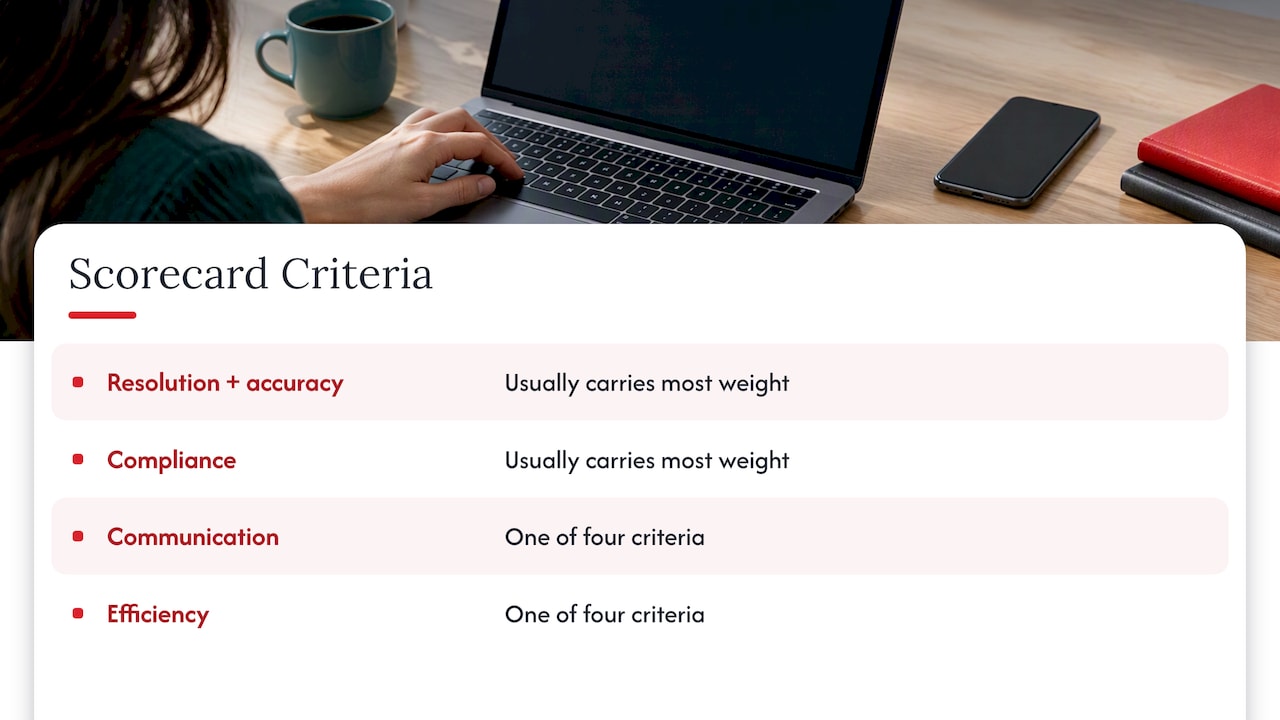
Resolution and accuracy
This is the core. Did the agent identify the real problem, give correct information about bonus terms, wagering, limits or payment status, and either solve it or hand it over properly? A confident wrong answer about a bonus condition is worse than a slow right one.
Compliance and process adherence
This group covers identity checks before account details are shared, required disclosures, correct use of internal procedures and escalation to second line when a case needs it. In a casino, it also covers how the agent reacts to signals of harm. Treat this group differently from the others (see the auto-fail section below).
Communication
Clarity, tone, grammar, structure and next steps. For multilingual teams, score language quality against the language of the player, not the language of the reviewer. Our guide to language quality assurance for iGaming operators goes deeper on that point.
Efficiency
Response time, pacing in live chat, and clean ticket handling in email. Efficiency should never outweigh accuracy. If it does, agents learn to close contacts rather than solve them.
How to weight criteria by channel
Weight by impact, and weight by channel, because a chat and a ticket fail in different ways. One published example for live chat assigns 30% to accurate resolution and 15% to response time and pacing. The email and ticket example in the same source gives 35% to complete, accurate resolution and 15% to clear structure and next steps.
Those figures are an illustration, not a standard. Use them as a starting point and adjust to your own contact mix. A workable 100-point layout for a casino or sportsbook might look like this:
| Criteria group | Live chat | Email and ticket |
|---|---|---|
| Resolution and accuracy | 30 | 35 |
| Compliance and process | 25 | 25 |
| Communication and tone | 20 | 20 |
| Efficiency (speed, pacing, follow-up) | 15 | 10 |
| Documentation and tagging | 10 | 10 |
Three rules keep a table like this honest:
- Fewer line items beat more. A tight scorecard has four to six categories. Twenty-line forms get skimmed and scored by gut feel.
- Prefer clear anchors. Write what a full score, a partial score and zero look like for each line, with a real example.
- Score the channel you are reviewing. Do not grade a ticket on pacing or a chat on email structure. Our comparison of live chat and email support for iGaming explains why players expect different things from each.
Auto-fails for regulated interactions
A percentage can hide a serious failure. A chat with perfect tone and a wrong answer about a withdrawal limit might still score 80%. That is why what counts as an automatic fail matters more than the overall score: it stops systemic risk being masked by strong results elsewhere.
Typical auto-fails include skipped identity verification, omitted legal disclosures, incorrect regulated information and serious breaches of customer trust. For a licensed operator, build the list around your own risk register. Sensible entries:
- Sharing account or personal data before the player is verified.
- Giving wrong information on deposits, withdrawals, fees, or KYC document requirements.
- Missing or ignoring a safer-gambling signal, such as a player describing chasing losses or asking about self-exclusion or limits.
- Promising an outcome the agent cannot guarantee, for example a payout date while the account is under review.
- Bypassing a required escalation to second line or the compliance team.
Keep the auto-fail list short. If everything is an auto-fail, nothing is. Agree each item with compliance, write one line explaining it, and review the list when your policies change.
What UK licensees need to reflect
The scorecard should connect to what the regulator expects, and you should know which parts are obligations and which are good practice.
The Gambling Commission’s customer interaction guidance says licensees must assess the overall effectiveness of their approach, and that this should include quality assuring individual interactions by spot-checking records, including chats, emails and records of changes in behavior. The same guidance expects interaction records to hold, at minimum, the customer’s identifier, the behavior that prompted the contact, the action taken, the advice or support given and the outcome.
What that means for your scorecard:
- Obligation: you assess effectiveness and spot-check real interactions. A documented QA program with reviewed samples supports that.
- Obligation in practice: interaction records must be complete. Add a “record kept and accurate” line to the scorecard so gaps surface in QA, not in an audit.
- Recommendation: weights, scoring scales, percentage targets and the auto-fail list are your design choices. The regulator does not prescribe a template.
The stakes are real. In 2025 the Commission fined Videoslots £650,000 for anti-money-laundering and social responsibility failures, including delayed customer due diligence and untimely customer interactions. Confirm the current wording of your licence conditions and codes with your compliance lead before you finalize the form.
Sampling: random plus targeted
A scorecard is only as good as the conversations you put through it. Reviewing the first five chats of the week, or only the ones agents pick, gives a flattering picture.
Use two layers. Random sampling gives general coverage, and targeted sampling covers high-risk contact types such as safer gambling conversations, restricted accounts and complaints. The first tells you how the team performs on average. The second tells you whether the contacts that matter most are handled properly.
A practical setup:
- Draw a random sample per agent per week, split across chat and email in proportion to volume.
- Add a fixed quota of targeted reviews: every safer-gambling flag, every self-exclusion or limit request, and a share of KYC and withdrawal disputes.
- Review every escalated complaint, since those already carry the most risk.
- Keep sample sizes the same for new starters and veterans, so scores are comparable.
For a team that is growing, new agents warrant a higher review rate in their first weeks. Taper it as their scores stabilize.
Calibrating reviewers
Scores only mean something if two reviewers give the same conversation the same result. To get there, reviewers score the same set of interactions independently and then discuss disagreements until their scoring aligns.
Run a calibration session at least monthly:
- Pick five to ten conversations, including at least one borderline compliance case.
- Each reviewer scores them alone, without seeing others’ results.
- Compare line by line. Note where gaps are widest.
- Rewrite the anchor text for any line that caused a split, then record the decision.
If you use automated or AI-assisted scoring, hold it to the same scorecard and test it against a human lead’s scores on a hand-scored set before you trust it. Our guide to AI in customer support for iGaming operators covers where that fits.
Using scores to coach, not to police
A scorecard that agents fear gets gamed. Quality assurance works better used developmentally: attaching numbers directly to agent records can make people defensive, while specific, actionable feedback improves service.
What that looks like week to week:
- Hold a short one-to-one with each agent covering two reviewed conversations: one strong, one to improve.
- Quote the exact line in the conversation and the anchor it was scored against.
- Look at patterns across agents. If ten agents miss the same bonus-term check, the fix is a knowledge base update, not ten coaching sessions.
- Feed recurring contact reasons back to product, payments and compliance.
- Track QA scores next to CSAT, first contact resolution and handle time. Our article on CSAT, FCR and AHT shows how to read them together.
The aim is to make QA the best source of operational insight you have, rather than a box ticked each month.
Keeping quality up during peak demand
Peaks are where scorecards earn their keep. During a major tournament, a jackpot drop or a promotion, ticket volume multiplies, temporary agents join and shortcuts creep in. The risk is that QA reviews fall just when error rates rise.
Plan for it before the peak:
- Raise the targeted sample for promo-related contacts, bonus terms and withdrawal queries.
- Review new and temporary agents daily for their first shifts.
- Run a short calibration before the event so reviewers use the same anchors.
- Keep the auto-fail list unchanged. Speed targets can flex. Compliance checks cannot.
- Check night-shift and weekend samples separately, since they often show different results from daytime.
We cover the full operating model in iGaming player support QA: the operator’s playbook.
Perspective: how we run QA on dedicated player support teams
We build and run dedicated, outsourced player support teams for licensed iGaming operators, and QA is part of how we do it, not an add-on. A named team without a scorecard is a team nobody can measure.
Our view is simple. Keep the scorecard short, keep the auto-fails tied to compliance, and make every score explainable to the agent who received it. We design our QA around written SLAs, so the operator knows what is measured, how often and what happens when a number slips.
The second point is peak readiness. Internal teams rarely have spare reviewers when volume surges. A managed team that launches in 4 to 8 weeks, with QA governance built in from the first shift, lets you keep the same review standard on a jackpot night as on a quiet Tuesday.
Finally, treat the scorecard as shared. Operators know their products and licence conditions best. We bring the review discipline and the staffing. Put both on one form and quality becomes something you can show to a regulator and to your own board.
Miroslav Maslovarić
Run QA with a dedicated team
If you want the scorecard, the reviewers and the agents handled by one team, our quality assurance and monitoring service covers sampling, calibration and reporting against written SLAs.
Current rates are listed on our pricing page. If you are weighing partners, our guide to evaluating outsourcing partner quality lists what to ask.
A starter checklist
Use this as a first draft, then calibrate it on real chats before rollout.
- Choose four to six criteria groups and set weights that total 100.
- Write three anchor levels for every line, with an example from your own queue.
- Agree a short auto-fail list with compliance and sign it off.
- Define random and targeted sample sizes by channel.
- Add a record-keeping line that mirrors the interaction log fields above.
- Run a first calibration with every reviewer and fix unclear lines.
- Launch with coaching only for the first month, then add targets.
- Review the scorecard each quarter and after any policy or licence change.
FAQ
How many criteria should a support QA scorecard have?
Four to six groups is enough for most teams, with a handful of scored lines in each. More than that and reviewers drift, scores lose meaning and agents cannot remember what is expected. Move rare risks into the auto-fail list rather than adding more scored lines.
Should compliance be scored or treated as pass/fail?
Both. Score the routine compliance behaviors, such as correct process and complete records, so you can coach on them. Make the serious ones, such as skipped verification or a missed safer-gambling signal, auto-fails so a high total cannot hide them.
How many conversations should we review per agent?
There is no regulatory number. Set a weekly random sample that you can review consistently, add targeted reviews of high-risk contacts, and raise the rate for new agents. Consistency matters more than volume, so keep it the same across agents and weeks.
Does the Gambling Commission require a QA scorecard?
The guidance expects licensees to assess how effective their customer interaction approach is, including spot-checking records of chats and emails. It does not prescribe a scorecard format. Ask your compliance lead to confirm how your program maps to your licence conditions.
Sources
- What Is a Support QA Scorecard? (unitQ)
- How to Build Support QA Scorecards That Agents Trust (unitQ)
- QA Scorecard: Framework, Examples and Template (Kaizo)
- Customer interaction guidance for remote gambling licensees (Gambling Commission)
- Measuring and Improving Service (iGaming Times)
- GB Gambling Commission issues £650,000 fine to Videoslots (iGaming Business)
Recommended