Chat Concurrency Strategy for iGaming Player Support
November 5, 2026A UK sportsbook’s peak season is not one period. It is a run of spikes: Cheltenham in March, the Grand National in April, Royal Ascot in June, a major football tournament when one is scheduled, and weekly Premier League volume from August to May. The operators that handle it well build the plan from the fixture calendar and their own ticket history, forecast contacts hour by hour, staff to that forecast and review every event afterward. This guide shows how to do it, with a focus on player support, KYC and payments.
TL;DR
- Build one annual peak calendar from fixtures, your own contact data and licence-driven workload, then rank each event by expected contact volume.
- Forecast by channel and by hour, not by day or week. Update the forecast as live data arrives.
- Cover spikes with split shifts, staggered breaks and a cross-trained reserve pool. Keep VIP and complex cases with human agents.
- Treat KYC, payments and affordability checks as peak-load workloads. UK rules do not relax when volume rises.
- Close every event with a blameless review and update the playbook before the next one.
Table of Contents
- Start with a calendar that ranks events by contact volume
- Forecast by hour and by channel
- Staff the shifts before the spike, not during it
- Keep KYC, payments and compliance in the plan
- Run the event: metrics, alerts and escalation
- Review every event and update the playbook
- When in-house capacity is not enough
- Perspective: peaks are decided months before kick-off
- Staff your peak with a dedicated support team
- FAQ
- Sources
Start with a calendar that ranks events by contact volume
The first job is a single document that lists every event likely to move your ticket volume, with a rough size attached. Many calendars stop at the fixture list. A useful one adds your own data: contacts per 1,000 active players on past event days, the hour the spike started and how long the backlog took to clear.
For a UK book, the recurring skeleton looks like this:
| Period | What drives volume | Planning note |
|---|---|---|
| August to May | Premier League season | Weekend and midweek evening peaks, repeated 38 times per club |
| Mid-February to mid-March | Six Nations, which typically runs almost weekly | Smaller but regular Saturday spikes |
| March | Cheltenham Festival | One of the clearest annual traffic peaks |
| April | Grand National | Many occasional bettors, so many new-player contacts |
| May | FA Cup Final | Single-day spike |
| June | Epsom Derby and Royal Ascot | Racing-led volume and monitoring pressure |
| Late June to July | Wimbledon, British Grand Prix, The Open | Several overlapping events |
| December to January | World Darts Championship over the festive period | Holiday staffing and promo traffic combined |
| Tournament years | World Cup, European Championship | The largest and least regular peaks |
Ofcom’s 2026 major events list confirms how the domestic summer stacks up: Royal Ascot, Wimbledon, the British Grand Prix and the Open all fall within a few weeks of each other. Check each year’s exact dates on the official event pages, because they move. A third-party UK sporting calendar also adds jumps racing from October to March and year-round boxing and Formula 1, which matter for steady baseline volume.
Size the peaks with real data
Web traffic is a reasonable proxy before you have your own numbers. Similarweb’s analysis of UK sportsbook sites found that March 2022 traffic rose 28% over February and April rose a further 9%, the pattern created by Cheltenham and the Grand National. Market-level figures tell the same story. The Gambling Commission reported that online real-event betting GGY rose 16% year on year to £625 million in April to June 2024, alongside UEFA Euro 2024. In January to March 2026, by contrast, GGY was £600 million, up 1%. Tournament quarters move the market far more than ordinary ones.
Tournaments also bring new players. A Blask and Ace Alliance report found the UK gained 5.6% APS at the 2022 World Cup, equal to 78,900 new players a month. New players mean more registration, verification and first-withdrawal contacts, which are the slowest and most regulated tickets to resolve. Blask’s 2026 analysis also showed that England’s first match drew more attention than any later stage. Plan your biggest staffing for the opening fixtures, not only the final.
Forecast by hour and by channel
Daily and weekly forecasts hide the problem. A Saturday that averages out fine can still have a 45-minute window at 3pm and again at 5pm when queues explode. One match-day support playbook recommends converting the fixture calendar and historical support data into an hour-by-hour forecast and staffing plan.
A workable method:
- Pull 12 months of ticket data by channel (live chat, email, social, phone if you offer it), tagged by contact reason.
- Overlay the fixtures. Mark kick-off, half-time, full-time and settlement times for each major event.
- Forecast each channel separately. Live chat spikes at the moment of a dispute. Email backlog builds after the event. Zendesk’s guidance for betting teams recommends forecasting each channel independently and combining history with current trends and known events.
- Add promotion calendars. Enhanced odds, free bets and deposit offers are separate drivers. Marketing should share its schedule with support at least a month ahead.
- Re-forecast as data arrives. Update the plan in the weeks before an event as registrations, deposits and early contact rates come in.
The contact mix matters as much as the count. In a peak, deposit and withdrawal status checks, bonus-term questions and account-access issues dominate. The match-day playbook suggests self-serving or automating those routine contacts and sending VIPs and complex issues to human agents. That protects agent time for the contacts where tone, judgment and compliance knowledge decide the outcome.
Staff the shifts before the spike, not during it
Hiring on the day of a Grand National is not a plan. The staffing model has three layers.
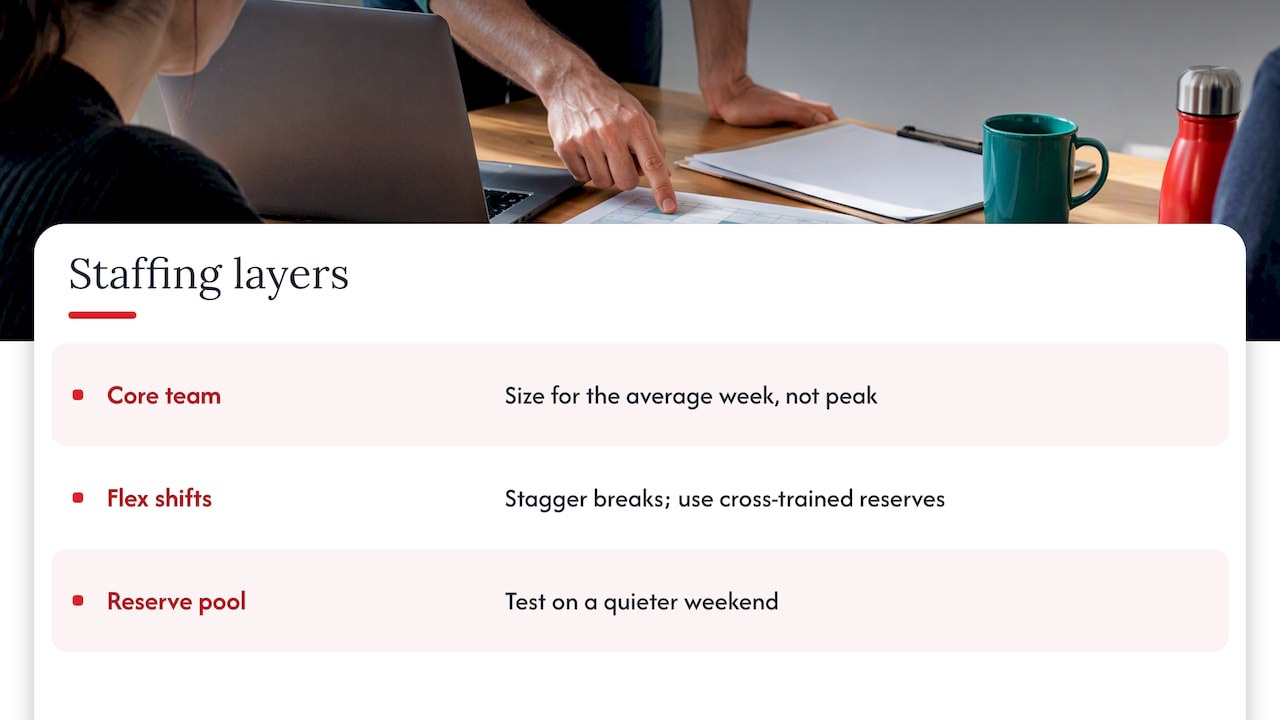
Core team. Permanent agents who know your products, markets and policies. Size them for the average week, not the peak.
Flex shifts. Zendesk recommends split shifts, staggered breaks and a reserve pool of cross-trained agents for betting spikes, with scheduling that stays transparent and fair. Stagger breaks so no queue is unattended at kick-off or full-time. Publish peak rotas early so agents can plan around them.
Reserve pool. Cross-train agents from email, payments or back office on live chat and first-line betting queries. Test them on a quieter weekend, not on the day. A reserve that has never taken a live chat will not help at 2:55pm on a Saturday.
What to train for
Peak-ready training is narrower than general onboarding:
- Bet settlement queries and how your rules handle void, dead heat, and cash-out disputes
- Withdrawal timelines by payment method and what you can and cannot promise
- Identity and source-of-funds requests, and how to explain them without losing the player
- Responsible gambling signals and when to escalate
- Macros and knowledge-base articles for the event itself, written before the event
Write a one-page event brief for every major fixture: expected volume, promotions live, known risks, escalation contacts, who has authority to approve exceptions. Our SOP playbook for player support sets out how to document those standards so a new agent can follow them under pressure.
Keep KYC, payments and compliance in the plan
Support does not work alone in a peak. A deposit stuck at the payment provider, a verification queue that doesn’t move or a trading suspension all arrive as tickets. Sports Betting Operator’s 2026 industry report advises pressure-testing trading systems, data feeds, payments, player-account management and customer-support tooling together, because failures rarely happen in isolation. The same report says realistic load tests should model different behavior profiles for NFL Sundays, World Cup knockouts and Formula One weekends. A UK equivalent would separate a Cheltenham Gold Cup afternoon from a Premier League Saturday.
A pre-event checklist for the operations side:
- Payments: confirm provider capacity, withdrawal processing hours and fallback routes. Our payout processing playbook covers how payment queries and support should connect.
- Verification: clear the KYC backlog before the event. Players who register for the big day and then hit a verification wall become your angriest tickets.
- Security and suppliers: the UKGC expects an annual independent security audit against RTS requirements. Newly licensed remote operators must complete the first audit within six months, and the audit scope includes supplier relationships, backups, access controls, monitoring, training, incident response and recovery. Your support outsourcer is part of that supplier picture.
- Documentation: the UKGC requires an operational model map showing where systems and activities sit and who provides them, with customer service named among the provider types. Keep it current when you add peak capacity.
- Infrastructure: for platform teams, AWS’s sportsbook guidance favors decoupling services and using automatic scaling rather than static over-provisioning for seasonal, spiky demand.
UK obligations do not pause at peak
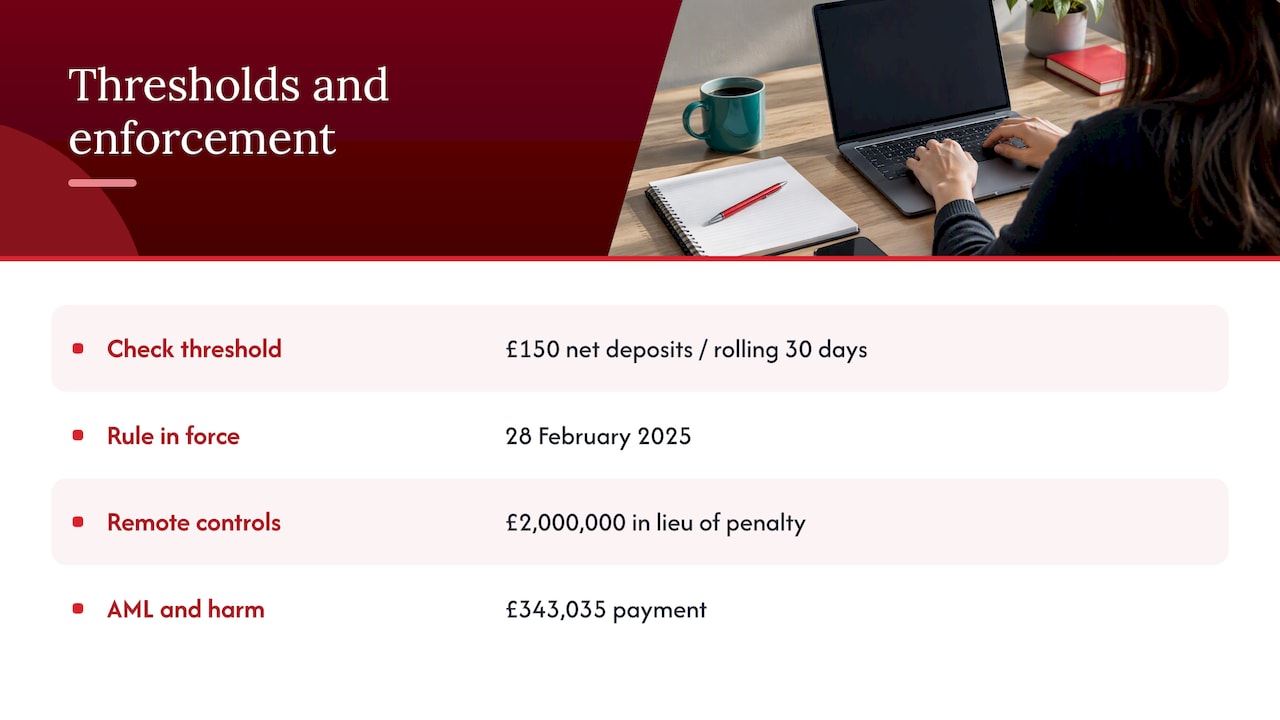
Volume is not a defense. The Gambling Commission’s rules on financial vulnerability require checks at £150 net deposits in a rolling 30-day period, in force from 28 February 2025. Operators must assess the result with other customer data, take proportionate action and record the rationale. The Commission also says indicators do not automatically require closing an account: action should fit the severity and context, from encouraging or applying deposit limits to immediate intervention. Agents need a script and an escalation route for this, because event weekends bring many new and occasional customers who cross that threshold quickly.
The Commission’s 2026 risk assessment notes that high-profile events such as Cheltenham and Royal Ascot create customer-monitoring challenges because activity is high and many customers are new or unfamiliar. That assessment rates British non-remote betting as high risk for money laundering, so the point is strongest for retail, but the monitoring lesson applies to any operator whose peak brings unfamiliar customers.
Enforcement history shows what failure costs. The Commission required £2,000,000 in lieu of a financial penalty after a review found failures in remote customer-interaction controls at four licensees. In another case it found failures in processes to prevent money laundering and protect people from harm and required a £343,035 payment. Its Greentube statement says AML controls must be implemented effectively, kept under review and revised. Your peak plan should therefore protect the time agents need for interaction and review work, not trade it for speed.
Run the event: metrics, alerts and escalation
During a peak, support is a control room. Pick a small set of numbers and watch them live. Zendesk identifies service level, occupancy, average handling time and backlog age as the control metrics, used to redistribute staff and reprioritize work in real time.
Set alert levels before the event. A practical set:
| Metric | Alert when | First response |
|---|---|---|
| Live chat queue wait | Above your SLA target for 10 minutes | Pull reserve agents onto chat |
| Backlog age (email) | Oldest ticket nears the SLA limit | Move email agents to oldest-first triage |
| Occupancy | Sustained near the maximum | Switch on automation for status queries |
| Withdrawal-related contacts | Sudden rise above forecast | Check with payments for a provider issue |
| Verification tickets | Backlog grows through the day | Add KYC capacity, brief on source-of-funds scripts |
The UK Government Service Manual’s advice is useful here: track user, technical and security metrics, use internal and external monitoring, write clear alerts and log errors in a ticketing system to spot recurring problems and capacity limits. Name one incident lead per shift, with authority to change routing and call in reserves.
Watch for silent failure. The match-day playbook warns that abandoned deposits, unresolved in-play disputes, VIP churn and compliance exposure can grow before complaint numbers make the problem visible. A queue that looks calm may simply be one that players gave up on. Track abandonment, not only answered contacts. For a closer look at what that costs, read our piece on the hidden cost of poor support during major sporting events.
VIPs deserve their own lane. A high-value player who loses a bet-settlement argument during Cheltenham will not wait in a general queue. Route them to named agents with authority to act.
Review every event and update the playbook
The plan improves only if each event feeds the next one. Google’s guidance on peak events recommends that teams identify business and system metrics and alert levels for each event and, afterward, review what happened, document lessons in a blameless retrospective and update the playbook.
Within a week of each major event, answer:
- How did actual contacts compare with the hourly forecast, by channel?
- When did service levels slip, and what was the cause?
- Which contact reasons were unexpected, and do they need a macro, an article or a product fix?
- Did any KYC, affordability or responsible gambling case wait longer than your policy allows?
- What would we change in the rota, the reserve pool or the escalation chain?
Feed QA findings into that review. Reading a sample of peak-day conversations shows what dashboards miss: tone, accuracy of settlement explanations, correct handling of vulnerability signals. Our player support QA playbook describes a review routine built for iGaming.
When in-house capacity is not enough
Some operators can staff the full plan themselves. Many cannot, because a peak needs far more people for a few days than a permanent team can justify, and recruiting and training take longer than the calendar allows. The usual options are a larger reserve pool, a seasonal contractor model or a managed outsourced team. If you are weighing hiring against outsourcing, our guide on scaling player support without hiring 50 agents sets out the trade-offs, and scaling without adding risk covers the control side.
Perspective: peaks are decided months before kick-off
We run player support teams for licensed iGaming operators, and the pattern is consistent. The operators that struggle on a big day rarely lacked effort on the day. They lacked a dedicated team that already knew their products, their policies and their escalation paths.
That is why we build named, dedicated teams rather than pooling agents across clients. We hire, train, equip and launch a team in 4 to 8 weeks, which fits inside the gap between the end of one season and the start of the next. Coverage runs 24/7 in 14+ languages across live chat, email and ticketing, with VIP and retention support, KYC and payments handling, second-line escalation and QA, all under written SLAs.
Our advice is to treat the peak calendar as a contract requirement, not an afterthought. Put forecast volumes, shift cover, response targets and escalation rules in writing, then test them on a mid-size weekend before the big event. If a plan has not been rehearsed, it is a hope.
Miroslav Maslovarić
Staff your peak with a dedicated support team
If your plan shows a gap between the contacts you expect and the agents you can field, we can close it. Workanova builds and runs dedicated, outsourced player support teams for licensed online casinos and sportsbooks, with a launch window of 4 to 8 weeks.
Published pricing starts at €7.15 per hour for a Customer Support Agent and €16.95 per hour for a Manager or Team Lead, plus a Workanova fee from €400 per month per seat. Second-line support is €1,800 to €3,200 per month per agent. See the full breakdown on our pricing page, or look at how we cover live chat, email and ticket support and VIP player support. For event-specific cover, start with our major event support coverage page, or talk to us through Workanova.
FAQ
When should a sportsbook start peak season planning?
Start at least one quarter before the first major event, and earlier if you need to recruit or onboard an outsourced team. A 4 to 8 week launch, as we offer, still needs time for forecasting, scripts and a rehearsal. Review and refresh the calendar after each event.
Which UK events cause the biggest support spikes?
Tournament football in World Cup and European Championship years is the largest, followed by Cheltenham, the Grand National and Royal Ascot. Similarweb’s data shows the clearest UK web-traffic peaks around Cheltenham and the Grand National. Your own ticket history should decide the ranking for your brand.
How many agents do we need for a peak?
There is no standard ratio. Take your hourly forecast by channel, divide by what one agent can handle at your target occupancy and handling time, then add cover for breaks and for KYC and VIP work. Re-run the calculation as live data arrives.
Can we automate peak support?
Yes, for routine contacts such as deposit and withdrawal status, bonus terms and account access. Keep VIPs, disputes and anything involving vulnerability or financial-risk signals with human agents, because UK rules expect proportionate, recorded action on those cases.
Sources
- UK Gambling Commission: Market overview, operator data to March 2026
- UK Gambling Commission: Market overview, operator data to June 2024
- Ofcom: Major events for PMSE licensees
- VisitBritain: The sporting season
- UK Sporting Calendar for Bettors 2026
- Similarweb: UK sports betting sites
- Blask: World Cup 2026 betting demand
- Blask x Ace Alliance: World Cup 2026 iGaming Demand Report
- Match-day surges: iGaming support playbook
- iGaming customer support strategies for high-demand moments
- Sports Betting Operator: How sportsbooks are preparing for 2026
- UK Gambling Commission: Security audit advice
- UK Gambling Commission: What you need to send when you apply for an operating licence
- AWS: Guidance for building an event-driven sportsbook
- UK Gambling Commission: Light-touch financial vulnerability checks
- UK Gambling Commission: 2026 money laundering and terrorist financing risks, betting non-remote
- UK Gambling Commission: PPB Counterparty Services Limited regulatory sanctions
- UK Gambling Commission: Settlement for Hillside (UK Gaming) ENC
- UK Gambling Commission: Greentube Alderney Limited public statement
- UK Government Service Manual: Monitoring the status of your service
- Google Cloud: Plan for peak traffic and launch events
Recommended