

Support Localization Strategy for UK-Facing iGaming Operators
November 24, 2026Workforce forecasting support for an online casino or sportsbook means two things: a method that predicts how many trained agents you need in each interval, and a way to fill the gap when the forecast says your team is too small. Historical contact counts are not enough for iGaming. Demand is driven by fixtures, jackpots and promotions, and in the UK it also carries compliance work that cannot be skipped when volume spikes.
This guide is for Heads of Player Support, CX and Operations at licensed operators. It covers what to forecast, which methods fit event-driven demand, how to turn a forecast into a roster, and what to do when the numbers say you cannot staff the peak yourself.
TL;DR
- Forecast from business drivers (fixtures, campaigns, new player acquisition), not only from last year’s ticket counts.
- Build compliance workload into the plan: KYC, source-of-funds checks and safer gambling interactions need staffed capacity at peak, not after it.
- Forecast by channel and skill. A chat agent, a VIP host and a second-line payments specialist are not interchangeable.
- Set a trigger: when the forecast exceeds your internal capacity by a set margin, a pre-trained outsourced team goes live.
- Review forecast against actuals after every major event and feed the error back into the model.
Table of Contents
- Why iGaming forecasting breaks standard models
- What you need to forecast
- Choosing a forecasting method
- Turning the forecast into a roster
- Planning for the people, not only the numbers
- Our perspective: forecast the gap, then decide how to fill it
- When internal capacity is not enough
- What Workanova provides
- Review the forecast after every event
- FAQ
- Sources
Why iGaming forecasting breaks standard models
Most forecasting guides assume demand that repeats weekly and seasonally. iGaming has that baseline, but it sits under spikes that standard models treat as noise.
A Sabio case study of a UK and Ireland sports betting and iGaming operation describes 1,100 agents handling demand spikes of 400 to 500% during sporting events. A spike of that size does not behave like an ordinary busy Monday. Registrations, deposits, in-play disputes and withdrawals arrive together, which is how the Comm100 match day playbook describes a major fixture: a week of volume compressed into a few hours.
Three features make the problem harder than a retail or telecom contact centre:
- Demand is event-driven. A kick-off time, a jackpot hitting a threshold or a promo email send creates the peak. The calendar is known in advance; the size is not.
- Contact mix shifts during the peak. Deposit failures and bet disputes dominate during a match. Withdrawal and verification contacts follow in the hours after it.
- Compliance work scales with volume. More new players means more identity and affordability checks, and more interactions where an agent may need to intervene.
What you need to forecast
A single “tickets per day” figure hides the decisions that matter. Break the forecast into layers.
Volume by channel
Live chat, email and tickets behave differently. Chat needs staffing in the interval the player writes. Email can absorb a delay measured in hours, within your SLA. Forecast them separately, then decide how much email work can move to a quieter interval. Our comparison of live chat and email support for iGaming covers what players expect from each.
Handling time by contact type
A password reset and a disputed in-play bet are both “one contact”, but they do not take the same time. Track average handling time by contact reason, because the mix shifts at peak and drags the blended figure up.
Skill and language
If you serve several markets, forecast each language queue. A peak in German-language contacts cannot be absorbed by English-speaking agents. Do the same for VIP, payments and KYC queues.
Compliance workload
This is the layer most generic guides leave out. The UK Gambling Commission’s customer interaction guidance, requirement 13 says licensees must take all reasonable steps to evaluate the effectiveness of their approach and be able to show the Commission the outcomes. In staffing terms, that means enough trained people to scrutinize activity and intervene when volume is highest. If your plan staffs chat to the SLA but leaves nobody to review a flagged account, the plan is incomplete.
The Commission’s anti-money laundering guidance on customer relationships lists identity verification and monitoring of deposits and withdrawals as part of managing the customer relationship. Both are recurring workloads you can forecast from registrations and payment volume.
Choosing a forecasting method
Time-series methods still have a place. Verint’s overview of call center forecasting methods covers Holt-Winters (triple exponential smoothing) and ARIMA as standard approaches for contact centres with good history. They work well for your baseline weeks.
They struggle when the driver is an event. For high-volatility demand, the same source points to driver-based forecasting, which ties staffing to business indicators such as marketing campaign spend and new player acquisition, instead of relying only on past contact counts.
| Method | Best for | Weakness in iGaming |
|---|---|---|
| Holt-Winters / ARIMA | Stable baseline weeks, seasonality | Misses one-off events and new promotions |
| Driver-based | Peaks tied to campaigns, fixtures, registrations | Needs clean data from marketing and product |
| Event uplift tables | Repeating fixtures (league weekends, cup finals) | Needs a few events of history per sport |
| Scenario ranges | Tournaments and jackpots with no precedent | Gives a range, not a single number |
In practice, combine them. Use a time-series model for the baseline. Add an uplift from your event calendar. Then run a low, expected and high scenario so the roster covers the high case through flexible cover rather than permanent headcount.
A worked example
Suppose your baseline for a Saturday evening hour is 300 chat contacts. Your last two comparable fixtures produced 3.5 times baseline in the hour around kick-off. A marketing send is planned that previous sends suggest lifts registrations. You would set the scenarios like this:
- Low: 3x baseline, about 900 contacts.
- Expected: 3.5x, about 1,050 contacts.
- High: 5x, about 1,500 contacts, in line with the kind of spike the Sabio case describes.
These figures are illustrative, not benchmarks. Take your own uplift from your own events, then divide the contacts by what one agent handles per hour on your concurrency and handling-time settings to get the headcount for each scenario.
Turning the forecast into a roster
A forecast is useful only when it becomes shifts. Follow these steps.
- Convert volume to workload. Multiply contacts by handling time for each channel and skill.
- Apply shrinkage. Add breaks, training, absence and meetings. Plan on the number of people you must schedule, not the number you need on the floor.
- Add the compliance layer. Reserve capacity for KYC reviews, payment checks and second-line escalations as separate work, not as a share of chat time.
- Match to intervals. Build the schedule in 15 or 30 minute blocks around the event calendar, with night coverage planned explicitly. Our guide on outsourcing night-shift player support covers the overnight gap.
- Set your gap. Compare the roster you can field with the high scenario. The difference is the capacity you need to source.
- Define the trigger. Decide in advance what forecast level activates extra cover, who approves it and how long it takes to go live.
Tooling and accuracy
Dedicated workforce management software helps. In the Verint case study, a global sports betting and iGaming provider moved 400 people to a new WFM platform in two days. Verint also reports that professional WFM tools can bring forecast variance from about 10% down to within 5%, and that attrition at that operator fell to 4%. These are vendor-published figures for one operator, so treat them as an example of what is possible rather than a guarantee.
A spreadsheet can still work for a small team if it holds the event calendar, contact reasons and a record of forecast against actual.
Planning for the people, not only the numbers
The CIPD workforce planning factsheet describes workforce planning as a core business process and frames it with the 5 Rs: right size, right shape, right skills, right site and right spend. Applied to player support:
- Right size: staff to the expected scenario, cover the high one flexibly.
- Right shape: separate first line, VIP, payments and second line, with team leads at a sensible span.
- Right skills: language, product knowledge and compliance training per queue.
- Right site: EU time zones and local-market knowledge for each licence.
- Right spend: compare the cost of permanent peak headcount with flexible capacity.
The Gambling Commission’s public statements show why training records matter. In its Greentube Alderney statement, it asks whether processes to test staff implementation of policies and controls are effective, recorded and demonstrable. A forecast that adds untrained agents at peak does not meet that bar. Plan the training lead time into the forecast.
Our perspective: forecast the gap, then decide how to fill it
We run dedicated outsourced player support teams for licensed operators, and the same pattern appears in most peak-event conversations. The forecast is usually reasonable. The problem is that the gap it reveals arrives too late to hire for.
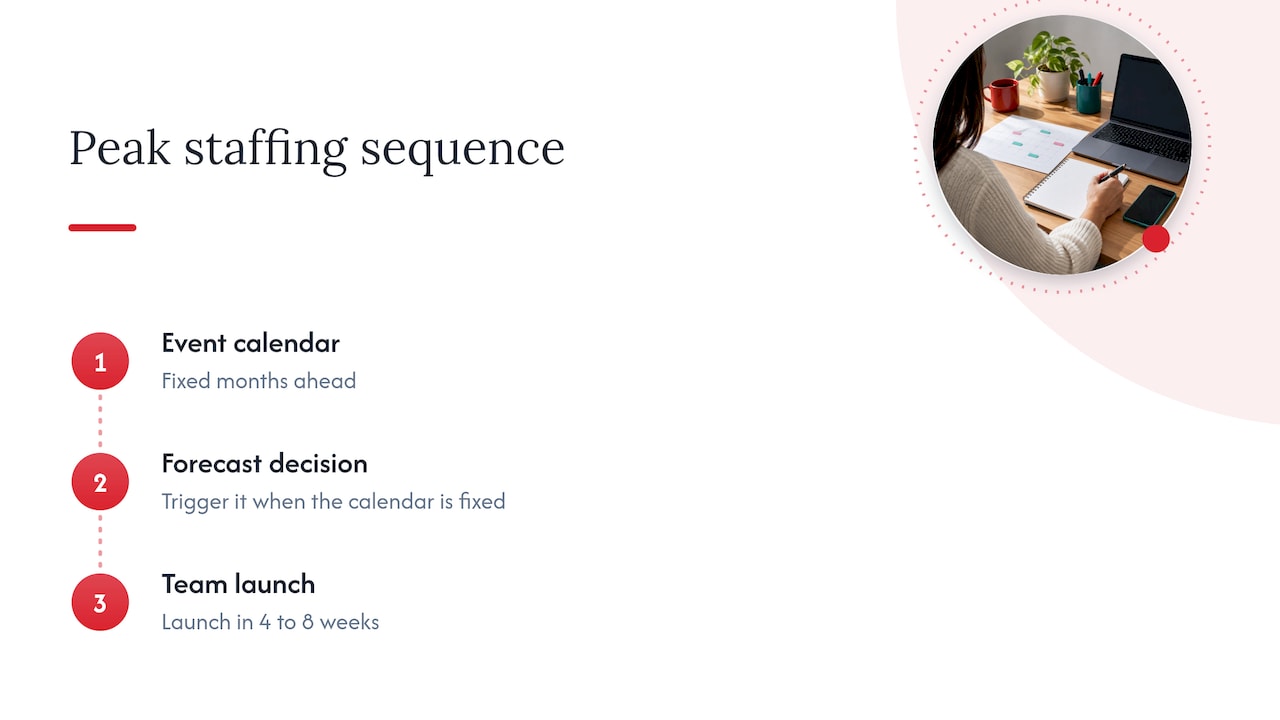
Hiring, training and equipping agents takes weeks. A World Cup, a jackpot or a promo calendar is fixed months ahead, so the forecast should trigger the decision then, not the week before. We launch a client’s own named team in 4 to 8 weeks, which is why we ask operators to share their event calendar early.
We also push operators to forecast quality, not only speed. Peak volume is where weak QA shows up: scripted answers on bet disputes, slow KYC replies, missed escalations. A forecast that holds the SLA but not the standard is not a good forecast. That is why we pair capacity planning with QA governance and written SLAs.
One more point: do not let VIP status bend the plan. Compliance checks apply to every account, and the staffing model should reflect it.
— Miroslav Maslovarić
When internal capacity is not enough
If your high scenario exceeds what you can staff, you have four options:
- Overtime and shift swaps: quick, but it raises attrition and errors if used repeatedly.
- Temporary hires: slow to train, and the compliance training burden is real.
- Freelance or generic call centre cover: fast, but usually lacks iGaming product and KYC knowledge.
- A dedicated outsourced team: trained in your processes and tools, scaled to the forecast, and covered by SLAs.
Our article on scaling player support without hiring 50 agents walks through the economics of the last option. If your concern is cost, our CFO page sets out the financial case.
What Workanova provides
Workanova is a Belgrade-based BPO with 37 employees, working in EU time zones. We hire, train, equip and launch your own named support team for online casinos and sportsbooks, with 24/7 coverage in 14+ languages across live chat, email and ticketing, VIP and retention support, KYC and payments handling, second-line escalation and QA, all under written SLAs. See our 24/7 iGaming player support outsourcing page for the full scope.
Current rates for agents, team leads and second-line support are listed on our pricing page.
Multiply your forecast headcount by the hours per interval, add the seat fee, and you have a first cost for the high scenario. Details are on the pricing page. For escalations and payment cases, see our 2nd line support service.
Review the forecast after every event
A forecast improves only when you compare it with what happened. After each major event, record:
- Forecast and actual volume per channel and interval.
- Handling time by contact reason.
- SLA attainment, abandoned chats and backlog at the end of the event.
- Compliance queue times: KYC, withdrawals, flagged accounts.
- Agent attrition and overtime in the following two weeks.
Use the error to correct your uplift tables. Our player support SOP playbook and QA playbook help you keep the standard steady while volume changes.
FAQ
What is workforce forecasting in player support?
It is the process of predicting how many agents, with which skills and languages, you need in each time interval. For iGaming it combines historical data with drivers such as fixtures, campaigns and new player registrations. It also includes compliance work like KYC and payment checks.
Which forecasting method works best for an online casino or sportsbook?
No single method wins. Use a time-series model such as Holt-Winters for your baseline, then add driver-based uplifts for events and promotions. Run low, expected and high scenarios for anything without precedent, such as a new tournament.
How far ahead should I plan for a major sporting event?
Earlier than your hiring lead time. New agents need recruitment, training and system access before they can handle live contacts, and compliance training needs to be recorded. For a dedicated outsourced team, we launch in 4 to 8 weeks, so plan the decision at least that far ahead of the event.
Does the UK Gambling Commission say anything about staffing levels?
It does not set an agent-to-player ratio in the guidance we cite. It does require licensees to evaluate their customer interaction approach and demonstrate the outcomes, which in practice means having enough trained staff to monitor and intervene during busy periods.
Sources
- Sabio: Betting on Innovation, Transforming Workforce Management
- Comm100: Dealing with Match Day Surges
- UK Gambling Commission: Customer interaction guidance, requirement 13
- UK Gambling Commission: Prevention of money laundering, customer relationships
- Verint: Call center forecasting methods and techniques
- Verint: Global sports betting and iGaming firm case study
- CIPD: Workforce planning factsheet
- UK Gambling Commission: Greentube Alderney Limited public statement
Recommended