

Workforce Forecasting Support for iGaming Player Support Teams
November 25, 2026Language coverage planning is the process of deciding which languages your player support must handle, on which channels, at which hours and to what standard, then staffing to that decision. For a licensed casino or sportsbook, it is an operational and compliance exercise first and a translation exercise second. This guide gives you a six-step method you can run with your own ticket data, plus the UK regulatory points that should shape it.
TL;DR
- Start from licences and markets, not from the languages your agents happen to speak. Every language you market in creates obligations.
- Size each language by ticket volume per hour of day, then tier it: full 24/7 live chat, extended hours, or email only.
- Keep KYC, responsible gambling and escalation workflows identical in every language. Inconsistency is the main compliance risk of multilingual setups.
- 24/7 coverage in one language needs roughly four to five full-time agents per seat before leave and sickness. Plan peaks separately.
- Audit quality per language, not just in aggregate. A strong English average can hide a weak German or Turkish queue.
Table of Contents
- What language coverage planning actually covers
- Step 1: Map markets, licences and obligations
- Step 2: Measure demand by language and hour
- Step 3: Tier your languages
- Step 4: Keep compliance identical across languages
- Step 5: Convert coverage into headcount
- Step 6: Audit quality language by language
- Build in-house or outsource by language
- Our perspective: coverage is a promise you make to players
- How Workanova can staff your language plan
- Common planning mistakes
- A 30-day plan to get started
- FAQ
- Sources
What language coverage planning actually covers
The phrase comes from sociolinguistics, where researchers separate language planning into four elements: corpus, status, acquisition and prestige planning. For an operator, only one of these does real work. Status planning is about the function a language is given and where it is used. In support terms, that means deciding which languages are official channels for which services, in which markets, at which times.
A coverage plan answers five concrete questions:
- Which languages do you support, and in which channels (live chat, email, ticketing, phone, social)?
- During which hours is each language staffed by a native or near-native agent?
- Which languages cover which request types: general queries, payments, KYC, VIP, complaints?
- What is the fallback when a queue is empty, overloaded or the agent is not fluent enough?
- Who checks that quality and compliance are the same across all of it?
If your current answer to the first question is a list and to the others is “it depends”, you do not have a plan yet.
Step 1: Map markets, licences and obligations
Begin with where you are licensed and where you market. The two are not always the same, and your regulator cares about both.
For UK-licensed operators, the Gambling Commission’s LCCP condition 3.3.2 on foreign languages is the starting point. In short, if you market to customers in a language other than English, the information they need to gamble safely, such as responsible gambling information, game rules and contractual terms, must be available in that language too. Read the full condition against your own licence type, as it does not apply to every licence category.
The practical consequence for support: the moment you add a language to your marketing, you add it to your support obligations. A Turkish landing page without Turkish-speaking agents and Turkish-language terms is a gap an auditor can find in minutes.
Build a simple market register with these columns:
- Market and licence (for example UK, Malta, Curaçao, Germany)
- Languages marketed in
- Languages players actually write in (often wider than the marketed list)
- Regulatory content that must exist in that language
- Local peak events (national football fixtures, racing festivals, public holidays)
Players rarely stay inside your assumptions. A UK-licensed brand will receive tickets in Polish, Turkish, Portuguese and Arabic from players who live in the UK. Your register should include the languages your data shows, not only the ones your brief lists.
Step 2: Measure demand by language and hour
Pull 90 days of tickets and chats from your helpdesk. For each language, record:
- Contacts per day, split by channel
- Contacts per hour of day, averaged and at the 90th percentile
- First response time and resolution time
- Share of contacts in categories with compliance weight: KYC, withdrawals, self-exclusion, deposit limits, complaints
- Language detection errors, meaning tickets tagged English that were not
The hourly profile matters more than the daily total. A language with 60 contacts a day, nearly all between 18:00 and 02:00 local time, needs an evening and night team, not a day team with a long tail. Many operators discover that their “English” demand is flat across the clock while a regional language is sharply peaked after work and during live events.
Also record the contacts you never see: players who abandon chat because no agent speaks their language. Chat abandonment by detected browser language is a useful proxy.
Step 3: Tier your languages
Not every language deserves the same service level. Tiering keeps cost proportionate and makes the promise to players honest. A workable model:
| Tier | Typical use | Channels | Hours | Staffing |
|---|---|---|---|---|
| 1: Core | Largest revenue markets | Live chat, email, VIP | 24/7 | Dedicated native agents in every shift |
| 2: Extended | Growing or regulated secondary markets | Live chat, email | Defined extended hours, for example 08:00 to 24:00 local | Dedicated agents, shared night cover |
| 3: Email only | Low volume, long tail | Email and ticketing | Business hours plus next-morning SLA | Pooled multilingual agents |
| 4: Assisted | Very low volume | Email, with translation tooling and native review | Best effort, clearly stated | Reviewed by a native speaker before sending |
Two rules keep this table honest. First, never advertise live chat in a language you cover only in tier 3. Second, anything touching responsible gambling or account restrictions should never sit in tier 4, because machine translation without review is a poor basis for a conversation about harm.
AI-assisted translation is useful for triage and agent assist, but it does not replace a fluent agent where the player is distressed, disputing a withdrawal or flagged for vulnerability.
Step 4: Keep compliance identical across languages
The most common failure in multilingual support is not poor grammar. It is divergence. One language team follows the latest KYC checklist, another uses the version from last spring. One team is trained to spot indicators of harm, another treats those signals as ordinary complaints.
The Gambling Commission’s SR Code 3.4.3 on remote customer interaction requires licensees to put effective systems and processes in place so customer interaction minimises the risk of gambling harm, including monitoring customer activity to identify harm. The Commission’s customer interaction guidance expects those processes to be embedded in how you operate. Nothing in it suggests that a player writing in Spanish is owed a lesser standard than one writing in English.
Industry commentary points the same way. Zendesk’s piece on compliance in iGaming support argues that fragmented, siloed multi-language setups are where inconsistent application of compliance creeps in, and that a unified support infrastructure is what bridges language delivery and operational policy.
In practice, that means:
- One playbook, many languages. Write each procedure once in a master language, then publish approved translations with version numbers. Our player support SOP guide shows how to structure these.
- One ticketing system and one tag taxonomy. A self-exclusion request must carry the same tag and route the same way in every language.
- Shared escalation paths. Second-line, compliance and VIP escalation should be reachable from every language queue, with the same response targets.
- Vulnerability training in every language. Agents need examples of how indicators of harm sound in their own language, including slang and indirect phrasing.
- KYC consistency. Document requests, rejection reasons and timelines should read the same way whatever the language. If you handle verification externally, see how we approach KYC outsourcing.
Step 5: Convert coverage into headcount
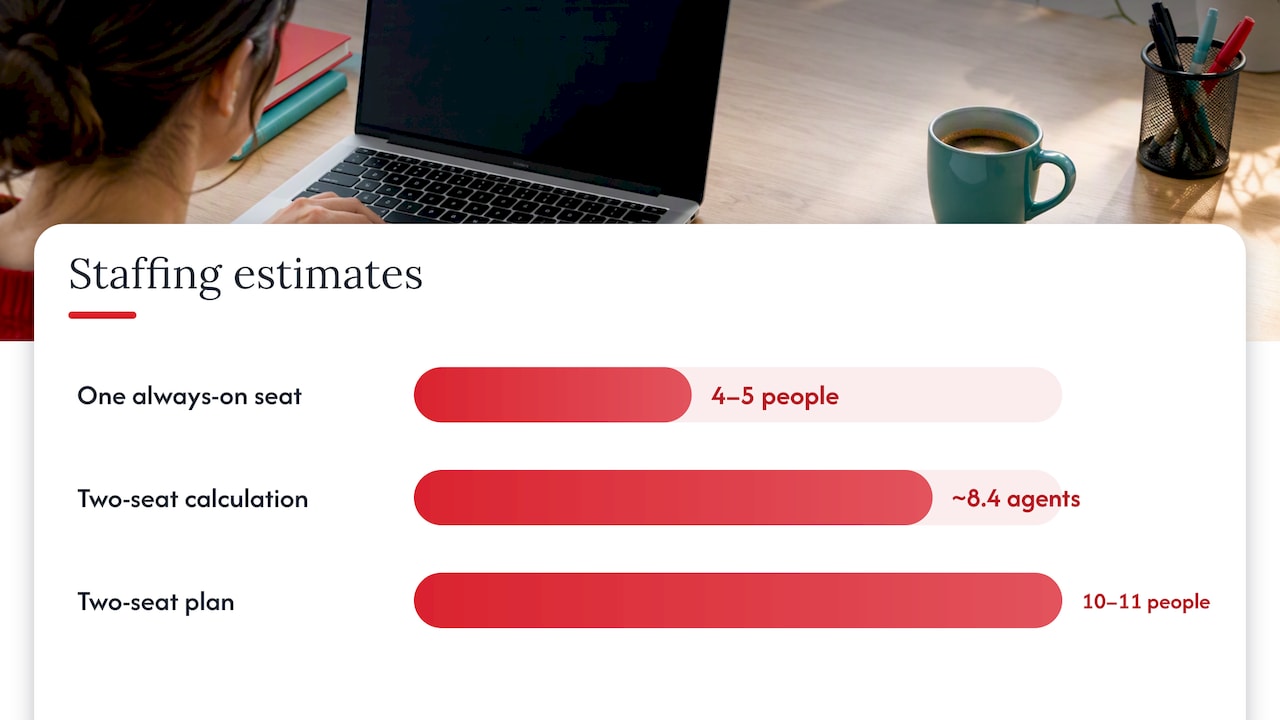
This is where plans usually fail on arithmetic. A seat staffed around the clock is open 168 hours a week. One agent works around 40 of those hours, and fewer after leave, training, sickness and breaks. So a single always-on seat in one language needs at least four to five people, and each additional concurrent chat seat multiplies that.
A worked example for one tier 1 language with two concurrent seats on every shift:
- 168 hours a week per seat, two seats: 336 seat-hours a week.
- Divide by roughly 40 paid hours per agent: about 8.4 agents.
- Add a margin for leave and sickness, plus a team lead: plan for 10 to 11 people.
Then price it. Current rates are listed on our pricing page. Your quote will depend on language, scope and shift pattern, so ask us for a quote based on your own volumes and languages.
For specialist work the model differs. Current rates are listed on our pricing page.
Plan peaks separately
Baseline staffing should not be sized for peak. Build a second layer for:
- Major tournaments and big sporting fixtures, when bet-related contacts and payment queries cluster around kick-off and full time
- Jackpot drops and large promotional campaigns
- Payday weekends and bank holidays
- Night shifts, where a single sick call can empty a language
For each language, define a surge trigger (for example queue wait above two minutes for 15 minutes), a surge response (cross-trained agents, pre-booked flex capacity) and a stand-down rule. Hiring and training new agents takes weeks, so the flex capacity has to be arranged before the event, not during it.
Step 6: Audit quality language by language
An aggregate QA score hides weak queues. Score each language separately on the same scorecard: accuracy, compliance steps followed, tone, resolution and use of approved wording. Have a native speaker review a sample, since a monolingual QA lead cannot judge idiom or register.
The UT Austin framework on the five Cs of language education (communication, cultures, connections, comparisons, communities) is built for teaching, but its core idea transfers: knowing words is not the same as understanding how people use them in their own community. In support terms, an agent should understand how a Turkish or German player describes a bonus dispute, not just translate the sentence.
Track these per language each month:
- QA score and compliance-critical fail rate
- First response and resolution time against SLA
- Reopen rate
- CSAT, where you collect it
- Escalation rate to second line
If a language falls below standard for two consecutive months, you need a remediation plan: coaching, replacement or temporary reallocation to another tier. Our guides to player support QA and language quality assurance go deeper on scorecards.
Build in-house or outsource by language
You do not have to choose one model for everything. A common pattern is to keep English and one or two core languages in-house, where product knowledge is deepest, and outsource the languages that are costly to hire for, need night cover or spike sharply.
Use these criteria per language:
- Local hiring pool. Can you recruit and retain native speakers where your office is?
- Volume per hour. Below a certain level, you cannot fill a shift productively.
- Time to launch. Entering a new market in weeks rather than quarters usually favours a ready team.
- Compliance load. Higher-risk work needs tighter control, which you can write into an SLA but must still audit.
- Peak sensitivity. Languages tied to specific events need elastic capacity.
Whichever you choose, the compliance responsibility stays with the licensee. Outsourcing moves the work, not the accountability, so the contract should give you access to QA data, call and chat records and training material. For a wider view, read our guide to outsourcing iGaming customer support.
Our perspective: coverage is a promise you make to players
We run dedicated player support teams for licensed operators from Belgrade, in EU time zones, and the pattern we see most often is simple. Operators plan languages when they enter a market and then stop looking. Six months later the language list is longer than the staffing plan, and the gap shows up at 3 a.m. during a big match.
Our view is that every language you list is a promise with three parts: hours, quality and compliance. Hours are visible to players immediately. Quality shows up in tickets and reviews. Compliance shows up only when something goes wrong, which is the worst time to discover that one language team works from an old procedure.
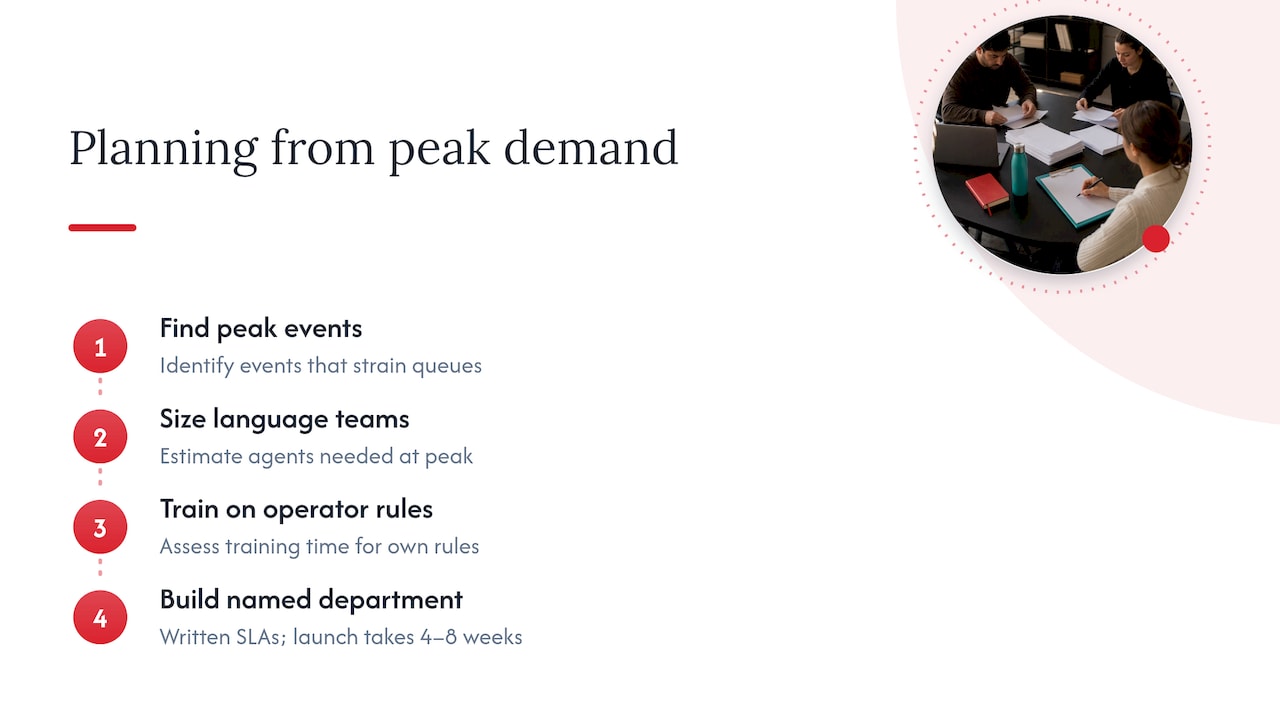
So we plan backwards from the peak. We ask which events strain the queue, how many agents each language needs at that moment, and how quickly they can be trained on the operator’s own rules. Then we build the team as the operator’s named department, with written SLAs, rather than a shared pool that serves several brands at once. Launching such a team takes 4 to 8 weeks for us, which is why we encourage operators to book capacity well before a major tournament rather than during the build-up.
If you take one thing from this article, make it this: review your language plan against real ticket data every quarter, and treat any language that has no owner as a risk.
— Miroslav Maslovarić
How Workanova can staff your language plan
If your plan shows gaps, we can fill them with a dedicated team trained on your products and procedures. We cover 24/7 in 14+ languages across live chat, email and ticketing, VIP support and second-line escalation, with QA and written SLAs across all of them. See how our multilingual customer support works, or check dedicated iGaming support teams if you want a full department launched in weeks.
Common planning mistakes
- Planning by country instead of by language. Players in one market write in several languages, and one language spans several markets.
- Treating all languages alike. Without tiers, you either overspend on the long tail or underserve the core.
- Ignoring time zones. A language spoken in one region may peak at hours when your agents are asleep.
- Skipping the fallback. When no agent is available, the player should see a clear message and a realistic response time, not a silent chat window.
- Forgetting regulated content. Terms, game rules and responsible gambling information need to exist in every language you market in.
- Reviewing once a year. Marketing adds languages faster than operations notices.
A 30-day plan to get started
- Week 1: build the market and language register, and export 90 days of ticket data.
- Week 2: analyse volume by language and hour, and assign tiers.
- Week 3: compare current rosters with the tiers, and calculate the headcount gap with the 168-hour method.
- Week 4: align SOPs, tags and escalation paths across languages, define surge triggers, and decide which languages to build, keep or outsource.
FAQ
How many languages should an online casino support?
Support every language you market in, plus any language that makes up a meaningful share of your real contacts. Then tier them, so only the highest-volume languages get 24/7 live chat. The number matters less than whether each language has a defined service level you can keep.
Do UK-licensed operators have to offer support in foreign languages?
The Gambling Commission’s LCCP condition 3.3.2 deals with foreign-language marketing and the information that must accompany it. It does not set a list of languages, but it ties your obligations to the languages you market in. Check the condition against your licence type, and take advice from your compliance lead if in doubt.
Is machine translation good enough for player support?
It works well for triage, language detection and agent assist on low-risk queries. It is a weak basis for conversations about withdrawals, account restrictions or signs of harm, where a fluent agent and approved wording matter. Use human review for anything with compliance weight.
How do I staff a language for 24/7 live chat?
Multiply 168 weekly hours by the number of concurrent seats you need, divide by around 40 paid hours per agent, and add margin for leave, sickness and a team lead. One always-on seat needs at least four to five people. Add flex capacity separately for major events.
How often should I review my language coverage plan?
Quarterly is a sensible rhythm, and always before a major tournament, a new market launch or a large campaign. Compare the plan with the latest ticket data by language and hour, and update tiers where demand has moved.
Sources
- LCCP condition 3.3.2: Foreign languages, UK Gambling Commission
- LCCP condition 3.4.3: Remote customer interaction, UK Gambling Commission
- Customer interaction guidance for remote gambling licensees, UK Gambling Commission
- iGaming compliance: redefined through customer support, Zendesk
- Language planning in An tUltach, TEANGA journal
- National Standards, Foreign Language Teaching Methods, UT Austin
Recommended