
Knowledge Base Governance for iGaming Player Support
November 12, 2026A responsible gambling referral is the moment your support team moves a player from a normal conversation to specialist help: the National Gambling Helpline, a treatment service, or a safeguarding route if the risk is immediate. For UK-licensed operators it is not optional goodwill. The Gambling Commission expects you to act in a timely, proportionate way when you identify a risk of harm, and to keep a record of what you did and what happened next. This guide covers what the rules require, who you can refer to, how to run the handoff, and how to prove the process works.
TL;DR
- The Commission’s customer interaction guidance expects timely, proportionate action on risk of harm. Signposting is one option alongside refusing service or ending the relationship, and every action needs a record.
- Refer to the right service: the National Gambling Helpline for advice and support, and the National Gambling Treatment Service routes for structured treatment.
- GamCare’s warm transfer service connects a player to the Helpline, but only trained staff can use it, and it cannot be used for a player at immediate risk of harm.
- Write down why you acted, what was said, what the player did afterwards and what happens next. Review those records to improve the process.
- Referral quality depends on frontline staff. Coverage at night, at weekends and during peak events matters as much as the policy.
Table of Contents
- What a referral means under UK rules
- Spotting the player who needs a referral
- Where you can refer players
- Making the handoff: signposting, warm transfer and written referral
- When the player is at immediate risk
- Documenting referrals so you can show they work
- Rules that keep moving
- Why peak periods break referral handling
- Our perspective
- How Workanova supports referral-ready teams
- A referral checklist for your team
- FAQ
- Sources
What a referral means under UK rules
The Commission’s formal guidance under SR Code provision 3.4.3 sets the baseline. Licensees must take timely, proportionate action when they identify a risk of harm. That action may include signposting a customer to specialist support, refusing service or ending the business relationship. You are also expected to keep records and consider the impact of your interactions.
Two points follow for a support manager.
- A referral is one tool on a ladder. Others include prompting use of gambling management tools, a cooling-off conversation, a limit change, or ending the relationship. The right rung depends on the evidence you have.
- The duty is about outcomes, not scripts. A pasted paragraph of helpline text sent to every upset player does not show a considered, proportionate response.
The guidance applies to remote licensees and has been in effect since 31 October 2023. Check the Commission’s site for the current wording before you update your procedures.
Spotting the player who needs a referral
Support agents see things your risk models do not. A player who writes at 4 a.m. about chasing a loss, or asks you to reverse a withdrawal for the third time, is giving you information. The Commission requires licensees to use a range of indicators relevant to their customers. The minimum categories are:
- customer spend
- patterns of spend
- time spent gambling
- gambling behaviour indicators
- customer-led contact
- use of gambling management tools
- account indicators
The guidance calls this list a minimum and expects you to add your own. Customer-led contact is the category your support team owns directly. Here is how that looks in practice.
Signals that come through support channels
- Direct statements: the player says they cannot stop, are hiding gambling from family or are gambling money meant for bills.
- Repeated requests to reverse withdrawals, raise limits or reopen an account after self-exclusion or a break.
- Distress in the message: apologies, desperation, mentions of debt, or threats to harm themselves. The last one is a safeguarding matter, covered below.
- Account signals an agent can see: sudden deposit increases, several failed payment attempts, or frequent logins at unusual hours.
- Third-party contact: a partner or relative writes in about a player’s gambling. Follow your data protection rules on what you can share, but log the contact and pass it to your responsible gambling team.
How to raise the subject
Agents need plain, non-judgmental language. Ask an open question, reflect what the player said, and offer support without lecturing. For example: “You mentioned the last few weeks have been difficult. Would it help if I told you about free, confidential support, and about tools on your account like deposit limits?” Avoid diagnosing. An agent’s job is to notice, respond and escalate, not to assess whether someone has a gambling problem.
Train agents to separate three situations, because each has a different path:
- A player who is frustrated about a lost bet or a bonus dispute. Handle as normal support.
- A player showing risk markers. Offer tools, signposting and a referral, and escalate to your responsible gambling team.
- A player at immediate risk of harm. Follow your safeguarding procedure, not the routine referral route.
Where you can refer players
The Commission lists the organisations that can help on its page of organisations that can help. Your agents should know what each one does so they can describe it accurately.
| Service | What it provides | When an agent uses it |
|---|---|---|
| National Gambling Helpline | Free, confidential advice, support and information 24 hours a day, 365 days a year, by phone or live chat | First signposting step for most players who say gambling is a concern |
| National Problem Gambling Clinic | Part of the National Gambling Treatment Service | Players who need structured treatment |
| NHS Northern Gambling Service | Specialist addiction therapy and recovery | Players who need clinical treatment in the areas it serves |
| GamCare treatment services | Referral through online forms, with the individual’s written consent | Professionals referring on the player’s behalf |
GamCare’s Helpline operates in England, Scotland and Northern Ireland. It offers a reduced service in Northern Ireland and can signpost to local services there, so build that into your agent guidance for players in the province.
Why the Helpline matters in practice: GamCare reported over 130,000 helpline calls and messages, with 7,100 referrals to further treatment services between April 2024 and March 2025. In January 2026 it made 996 referrals to treatment and peer-based support, up 48% year-on-year. GamCare also says the initial conversation is the critical turning point for someone seeking help. That is the conversation your agents are positioned to start.
Making the handoff: signposting, warm transfer and written referral
There are three levels of referral, from lightest to most involved.
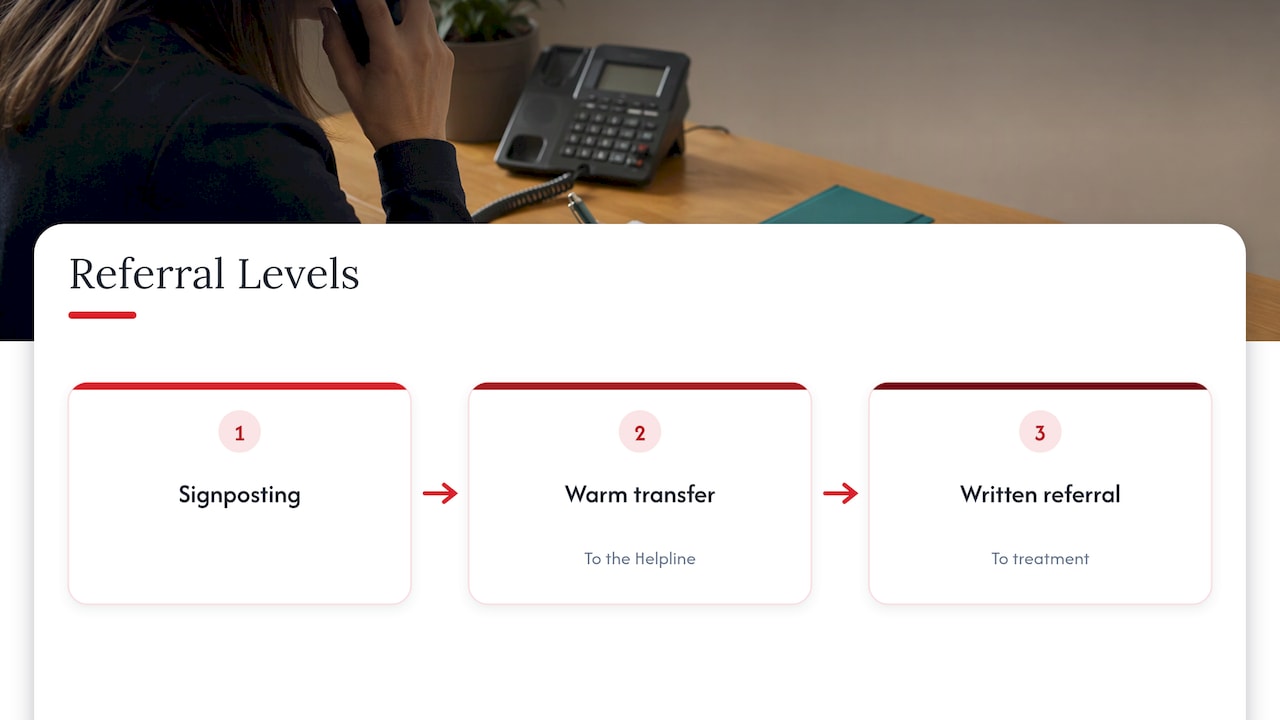
1. Signposting
The agent gives the player the name and contact route of the Helpline or another service and explains that it is free and confidential. This is the baseline. Put the wording in a macro that agents can personalise, not paste.
2. Warm transfer to the Helpline
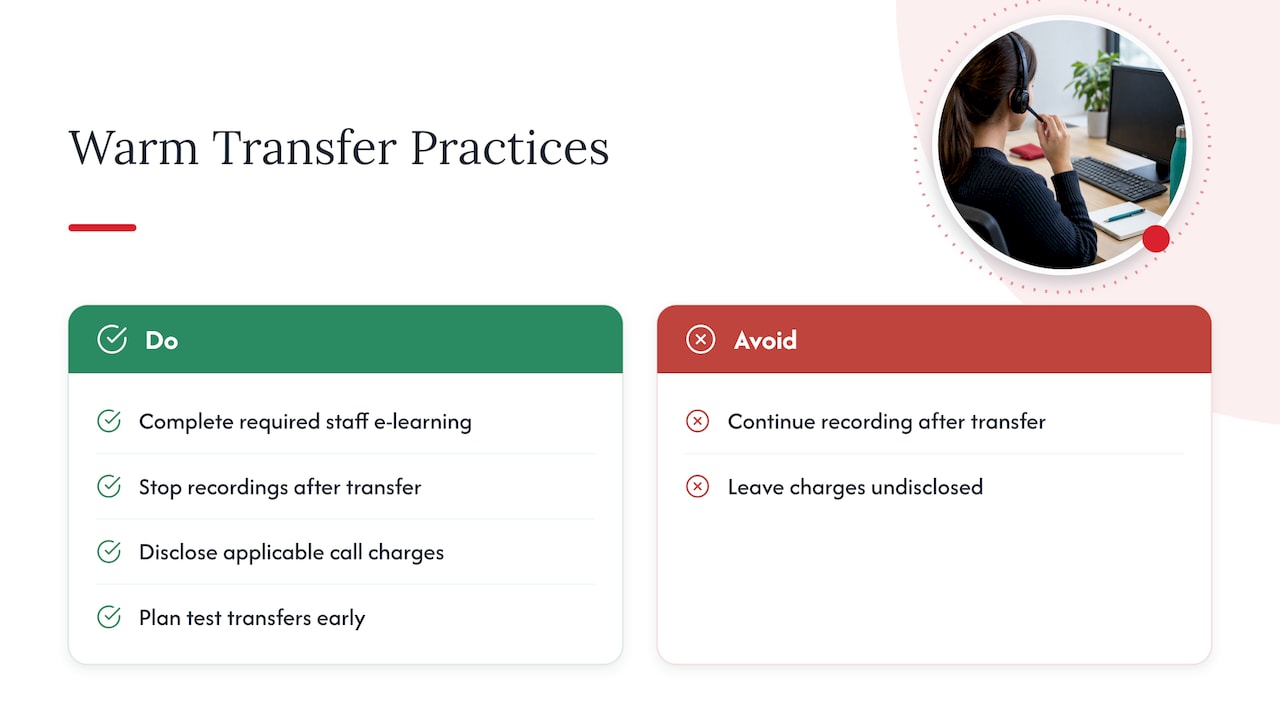
GamCare runs a Helpline Transfer Service. It can transfer customers directly to the National Gambling Helpline, and staff must complete the required e-learning before making transfers. According to GamCare’s FAQs, the service does not require technical integration between call-handling systems. Call recordings must stop when the transfer is complete, and any call charges that apply to a transferred customer must be identified to GamCare and communicated to the customer each time.
GamCare also recommends internal monitoring of attempted transfers and staff feedback, although it is not a requirement. Plan test transfers early, because the technical conditions above get flagged during testing.
A warm transfer needs a phone line. If your support runs mainly on live chat and email, decide in advance how those agents hand a caller-style referral on: signpost with the Helpline’s live chat option, or route the contact to a trained colleague who can make the transfer.
3. Written referral to treatment
Professionals can refer into GamCare’s treatment services through online forms, provided they have written consent from the individual. Consent is not something an agent assumes from a sympathetic chat. Your procedure should say who obtains it, how it is recorded, and which information goes on the form. Keep the information you pass to the minimum the referral needs.
When the player is at immediate risk
The National Gambling Helpline is not a crisis service. GamCare states that staff cannot transfer customers at immediate risk of harm and should follow their own organisation’s safeguarding procedures.
That means every operator needs a written safeguarding route before the first transfer is made. At minimum it should cover:
- the phrases and situations that trigger it, such as a player saying they intend to harm themselves
- who the agent contacts immediately, on every shift including nights and weekends
- what the agent says to the player while waiting
- how the contact is documented and reviewed afterwards
Agents should never improvise this. Have your responsible gambling lead and, where relevant, your legal or compliance team approve the procedure and run scenario practice, so the first time an agent faces it is not the first time they have read it.
Documenting referrals so you can show they work
The Commission’s guidance expects operators to record actions and interactions: why they acted, what was said or done, the customer’s behaviour afterward, whether further action is needed, and what happened next. Use that as the structure of your referral record.
| Field | What to capture |
|---|---|
| Trigger | The indicator or statement that led to the action |
| Action | Signposting, tool offered, warm transfer, written referral or escalation |
| What was said | A short factual summary, not a transcript dump |
| Player response | Accepted, declined, no reply |
| Follow-up | Behaviour after the contact and whether further action is needed |
| Owner | The agent and the responsible gambling team member who reviewed it |
The Commission’s earlier guidance treated customer interaction as an ongoing process of observation, action and outcome and said operators should trial and evaluate different approaches. You can apply the same logic with a simple monthly review:
- Count referrals by type, channel and shift.
- Sample a set of referral conversations for quality: was the language non-judgmental, was the right service named, was consent handled correctly?
- Check follow-up: did the player’s activity change, and did a second contact happen?
- Feed what you learn into agent coaching and macro updates.
A QA scorecard line for responsible gambling handling, scored on every sampled risk conversation, is the quickest way to make this routine. Our SOP playbook for player support standards shows how to build that kind of scorecard.
Rules that keep moving
Referral routes and expectations change. In July 2026 the Commission said it would introduce Financial Risk Assessments in stages to identify customers in financial difficulty and to improve operator processes. GamCare also describes a move from voluntary funding to a statutory levy, with a target of £90 to £100 million a year by 2027. Neither changes your duty to act on risk of harm today, but both point to more scrutiny of how frontline conversations are handled.
Build a quarterly check into your calendar: confirm service names, contact routes and the Helpline’s availability by region, then update agent guides and macros the same week.
Why peak periods break referral handling
Referral quality drops when queues grow. A jackpot drop, a major tournament or a big promo multiplies ticket volume, and agents under pressure shorten conversations. The conversations that most need time, the distressed or risk-flagged ones, are the first to be rushed or missed. Night shifts add a second problem: fewer people, fewer senior colleagues to escalate to, and the same duty to act.
Three safeguards help:
- Give risk-flagged contacts their own queue or priority tag so they are not buried in a spike.
- Keep a trained second-line agent or team lead on every shift, not just office hours.
- Cap the handling-time pressure on those contacts. A metric that rewards speed should not apply to a referral conversation.
Our perspective
We run dedicated player support teams for licensed operators, and the pattern we see is consistent: referral policy is rarely the problem. Staffing is.
A policy that depends on a calm, well-trained agent with time to spare fails the first night a promo triples the queue. We design the support team around that reality. Each client gets its own named team, trained on the operator’s own responsible gambling procedures, with second-line escalation and QA built in, so a risk-flagged contact has somewhere to go at 3 a.m. as well as 3 p.m.
We also believe referral handling belongs in QA, not only in compliance. Scoring every sampled risk conversation for tone, correct signposting and clean documentation gives you evidence for the Commission and a coaching loop for agents. Our written SLAs and QA governance are designed to make that visible to the operator.
Outsourcing support does not move the accountability: the licence stays with you. What it can do is give you a fully staffed department, with 24/7 coverage, trained to your procedures, in 4 to 8 weeks.
Miroslav Maslovarić
How Workanova supports referral-ready teams
We build and run outsourced player support teams for licensed iGaming operators: live chat, email and ticketing, VIP and retention support, KYC and payments handling, second-line escalation and QA, with 24/7 coverage in 14+ languages. Teams are trained on your procedures, including how to spot, escalate and document a responsible gambling concern, and launched in 4 to 8 weeks.
Current rates are listed on our pricing page. See the pricing page for details, or read how a dedicated team is launched in weeks. If you want a team that can handle risk conversations on night shifts, our 2nd line support service is where those contacts are escalated.
A referral checklist for your team
Use this as a starting point for your own procedure, and have your responsible gambling lead approve the final version.
- Define the indicators agents watch for in support contacts, alongside your system-level indicators.
- Write macros for signposting that agents can personalise.
- Decide who completes GamCare’s required e-learning and who is authorised to make warm transfers.
- Document the consent step for any written referral to treatment.
- Write and rehearse the immediate-risk safeguarding route for every shift.
- Record trigger, action, what was said, player response and follow-up for every referral.
- Review referrals monthly, sample them for quality and update coaching.
- Recheck service names, contact routes and regional availability every quarter.
FAQ
Is a responsible gambling referral the same as signposting?
Not exactly. Signposting means giving the player the details of a support service. A referral can go further: a warm transfer to the National Gambling Helpline, or a written referral to treatment with the player’s consent. Under the Commission’s guidance, signposting is one of several proportionate actions, alongside refusing service or ending the relationship.
Can any agent transfer a player to the National Gambling Helpline?
No. GamCare’s transfer service requires staff to complete its e-learning before they make transfers. Agents who have not done so should signpost the Helpline and escalate to a trained colleague.
What if the player is in crisis?
The Helpline is not a crisis service, and staff cannot transfer a customer at immediate risk of harm through the transfer service. The agent follows your safeguarding procedure, which should be written, rehearsed and available on every shift.
Do we need the player’s consent for a referral?
For a written referral into GamCare’s treatment services, yes: professionals need written consent from the individual. For signposting, you are giving the player information, so there is no referral to consent to, but you still record what you did.
What should we record after a referral?
Record why you acted, what was said or done, the player’s behaviour afterwards, whether further action is needed and what happened next. The Commission’s guidance expects this, and it is what lets you review and improve your process.
Sources
- Customer interaction guidance, Requirement 8 (Gambling Commission)
- Customer interaction guidance, Requirement 5 (Gambling Commission)
- Organisations that can help (Gambling Commission)
- Helpline Transfer Support FAQs (GamCare)
- Our Model of Care (GamCare)
- GamCare enters statutory levy era (GamCare)
- Record numbers of National Gambling Helpline callers referred to treatment (GamCare)
- Interacting with the customer (Gambling Commission)
- Commission to introduce Financial Risk Assessments in a staged approach (Gambling Commission)
- Explainer: The Statutory Levy (GamCare)
Recommended