
Support QA Scorecards for iGaming: Build One That Works
November 11, 2026
Responsible Gambling Referrals: A UK Operator’s Guide
November 13, 2026Knowledge base governance is the set of roles, rules and workflows that decides who writes, approves, updates and retires every support article, and who can prove it. For a UK-licensed casino or sportsbook, it is what keeps agents giving the same correct answer on bonus terms, withdrawals, KYC and safer gambling at 3 a.m. as at 3 p.m. Creating a knowledge base is a one-off project. Governing it is an operating discipline.
This guide covers the framework, the roles, the review cadence, access and audit controls, the UK regulatory angle and the metrics that show it works.
TL;DR
- Governance is the accountability layer: named owners, approval rules, review dates, version history and retirement. A repository without them is just a pile of pages.
- Give every article one accountable owner and a backup. Set review cycles by risk, with event-driven reviews after policy, promo or regulatory changes.
- Restrict editing, log changes and keep version history. In the UK, the Gambling Commission and ICO expect records and evidence, not good intentions.
- Track overdue and unowned articles, stale-content rate, search failures and QA findings. Start with a small pilot area, then expand.
- If you outsource support, governance must cover the vendor’s agents too, with a written handover and shared ownership rules.
Table of Contents
- What knowledge base governance means
- The components of a working framework
- Roles: who owns, writes, approves and retires
- The article lifecycle, step by step
- Review cadence: how often is often enough
- Access, version history and audit trails
- UK regulatory considerations for licensed operators
- Metrics that show governance is working
- Our perspective: governance has to survive peaks and handovers
- Where Workanova fits
- A 30-day starting plan
- FAQ
- Sources
What knowledge base governance means
A knowledge base answers the question “what do we tell the player?” Governance answers a different one: “who decided that, when, and is it still true?”
APQC separates the two ideas. Knowledge management helps information reach the right people at the right time. Governance sets the roles, decision structures, accountability, standards and controls that make that flow reliable rather than merely available.
In practice, a knowledge-base governance model is an operating model that controls ownership, drafting, approval, review, quality measurement, access, updating, archiving and retirement. Simply standing up a help center does none of that.
For iGaming the stakes are concrete. A stale article on wagering requirements produces a wrong answer, a complaint and possibly a regulatory question. An outdated KYC checklist slows verification or lets a gap through. A promo article that stays live after the promo ends creates disputes. Support teams also work fast and in shifts, so errors repeat at volume before anyone notices.
The components of a working framework
The framework we reviewed lists the pieces most teams need. Translated for a player support department, they look like this:
- Governance charter. One page stating scope (public help center, internal agent articles, macros, escalation guides), who has authority, and how disputes are settled.
- Ownership and RACI rules. Who is responsible, accountable, consulted and informed for each knowledge domain.
- Templates and metadata. A fixed article layout with fields for owner, status, version, last-reviewed date, next-review date, risk tier and jurisdiction.
- Draft-to-publish and retirement workflows. A defined path from request to live article, and from live article to archive.
- Risk-based review schedules. More frequent checks for content that can cause financial or regulatory harm.
- Approval and escalation rules. Who signs off what, and what happens when an owner does not respond.
- Access and version-control policies. Who can edit, who can read restricted content, and how changes are tracked.
- Feedback and correction SLAs. How fast an agent-reported error is fixed.
- Retention and disposal rules. How long old versions and logs are kept.
- Audit evidence and KPI reporting. The records you can show a regulator, auditor or board.
You do not need all ten on day one. You do need the first four, because everything else hangs off them.
Roles: who owns, writes, approves and retires
The most common governance failure is shared ownership, which in practice means no ownership. The guidance we used is clear: assign one accountable owner and a backup to each knowledge domain. Subject-matter experts validate operational accuracy, editors improve usability, approvers confirm relevant requirements and frontline agents flag gaps. The owner makes lifecycle decisions and resolves conflicts.
A COBIT-aligned implementation guide recommends the same shape: named knowledge owners, stewards or editors, approvers and repository administrators, tied together with a RACI matrix. The UK Institute of Scientific and Technical Communicators describes a support-documentation model where the product owner is accountable, while a writer, support engineer and subject-matter expert create and validate the content together.
Here is how that maps to an operator:
| Domain | Accountable owner | Validates accuracy | Approves before publishing |
|---|---|---|---|
| Bonuses and promotions | Head of CRM or promotions | Promo manager | Compliance, for terms and advertising rules |
| Deposits and withdrawals | Head of payments | Payments analyst | Compliance, for limits and source-of-funds wording |
| KYC and verification | KYC or compliance lead | Senior KYC analyst | MLRO or compliance officer |
| Safer gambling | Safer gambling lead | Support team lead | Compliance |
| Account and technical issues | Head of player support | Second-line support | Support operations |
Two rules keep this table honest. First, every live article has a named owner, and high-risk content needs subject-matter and compliance approval before it goes live. Second, the owner is someone with real authority over the underlying process. The UK Government’s guide for a Knowledge Asset Senior Responsible Owner makes the same point at organization level: the SRO should be senior, able to influence the business areas and resources that deliver outcomes, and able to provide oversight and coordination across the organization. For a support knowledge base, that is usually the Head of Player Support, with compliance holding the veto on regulated topics.
Agents belong in the process. They see broken articles first. Give them a one-click way to flag an error, and a promise that flagged errors get a response inside a set time.
The article lifecycle, step by step
A controlled lifecycle can run from gap identification through drafting, SME review, quality review, approval, publication, monitoring, scheduled review and update, then merge, archive or retirement. For a support team, a working version looks like this:
- Identify the gap. Source it from ticket tags, search failures, QA findings and agent flags.
- Draft from the template. Use the standard layout and fill in metadata first, owner and risk tier included.
- Subject-matter review. The domain expert confirms the process described is the process that actually runs.
- Quality review. An editor checks wording, length, tone and whether an agent could follow it mid-chat.
- Approval. Low-risk articles need the owner. High-risk articles also need compliance sign-off.
- Publish and announce. Tell the team what changed and why, not just that something changed.
- Monitor. Watch usage, helpfulness ratings and the tickets the article should have prevented.
- Review on schedule or on trigger. See the next section.
- Update, merge, archive or retire. Never leave a superseded article live.
Approval routing is where most teams lose time. A tool that supports approval queues, audit logs and task verification helps here, and an approval workflow platform can be a reasonable way to route reviews and keep a record of who signed off. Whatever you use, the test is simple: can you show who approved the live version of any article and when?
On rollout, the content-governance guidance we used recommends a risk-led approach: test the process on a small, representative content area before expanding it. For most operators, the withdrawals and bonus-terms articles are the right pilot, because they are high-volume and high-risk at once.
Review cadence: how often is often enough
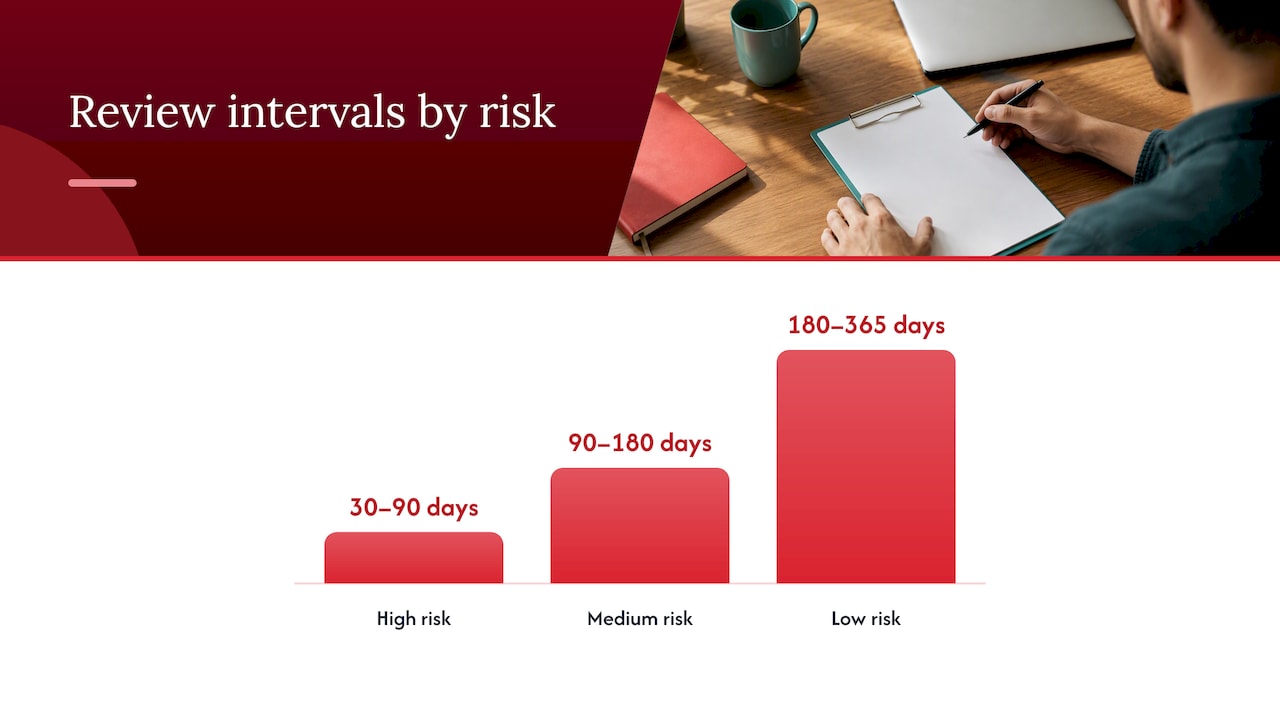
Review frequency should reflect risk, usage and feedback. The framework we reviewed gives high-risk content a 30 to 90 day cycle, medium-risk content 90 to 180 days and low-risk content 180 to 365 days, with event-driven review after policy changes, releases, incidents or audit findings. Treat those as a starting point and adjust to your own risk appetite.
| Risk tier | Typical iGaming content | Scheduled review | Event triggers |
|---|---|---|---|
| High | KYC and AML steps, withdrawal rules, bonus terms, safer gambling and self-exclusion | Every 30 to 90 days | Licence condition change, regulator guidance, payment provider change, promo launch or end |
| Medium | Account management, game rules, verification FAQs | Every 90 to 180 days | Product release, incident, QA trend |
| Low | General how-to, site navigation | Every 180 to 365 days | Redesign, feedback spike |
The ICO’s guidance on policies and procedures points the same way: review on a documented schedule, and update without undue delay when operations, court or regulatory decisions, or regulatory guidance change. It also expects each document to show a version number, owner, review date and change history.
A review is not a rubber stamp. At review, the owner confirms whether the guidance still applies, makes or requests corrections, and records the review even when nothing changed. That record is your evidence that the review happened.
Deal with neglected content decisively. The same guidance says unowned or outdated content should be corrected, replaced, restricted, archived or removed, with escalation for high-impact pages that lack an owner or carry unresolved review comments. Even outside gambling, public bodies write this duty into policy: one NHS ambulance trust’s procedural documents policy makes the author responsible for keeping content current, relevant and updated promptly.
Access, version history and audit trails
Support knowledge often contains things you do not want widely editable: fraud indicators, escalation thresholds, VIP handling rules, payment routing. Governance has to cover who can change it and how you prove what changed.
Editing and visibility. The COBIT-aligned guide advises restricting editing to trained contributors, placing sensitive content in restricted permission groups, keeping version history and change notes, and retaining access-control evidence. Each published item should carry an owner, last-reviewed date, next-review date, version history and a change note saying what changed and why.
Document status. The ICO’s version and document control policy is a usable model. It requires significant documents to show whether they are draft, published, superseded or withdrawn, and to record version number, responsible team, author or owner, distribution and version history. It also calls for full reviews periodically, at least within 36 months. That is a ceiling for low-risk material, not a target for your bonus terms.
Permissions hygiene. On access to personal information, the ICO recommends limiting it to authorized staff, assigning permissions through a formal process, restricting privileged access, logging access, reviewing rights regularly and removing them when roles change or employment ends. For a support team with shift churn and vendor staff, the leaver process matters most.
Privileged administration. The NCSC suggests tying privileged changes to an internal change request or support ticket, recording detailed audit information, and applying stronger controls such as multi-person authorization and phishing-resistant MFA to highly privileged access involving customer data.
Audit readiness. A practical audit checklist covers permissions for departed users, guests and service accounts, retained version history, tested restoration of prior versions, and preserved activity logs, approvals, ownership inventories and retention documentation. Test a restore before an auditor asks you to.
UK regulatory considerations for licensed operators
None of the sources here says a knowledge base is itself a licence requirement. The link is indirect but strong: the Gambling Commission expects you to control and evidence what customers are told and what your policies say. Your knowledge base is where agents get those answers.
- Customer interaction. For remote licensees, the Commission’s customer interaction guidance, in force from 31 October 2023, requires you to evaluate how effective interactions are, including quality assurance through spot-checking records such as chats and emails. Spot checks can only judge an agent against a standard, and the knowledge base is that standard. If it is stale, QA scores are meaningless.
- Interaction logs. The same guidance says an incident log should at minimum identify the customer, the behavior or activity that prompted the interaction, the action, advice or support given, and the outcome. Your safer gambling articles should tell agents exactly what to record.
- Records of what was communicated. Commission guidance on customer relationships under POCA expects operators to keep records of what information was given to customers, why and what considerations were made, and to have policies, procedures and controls to comply with their obligations.
- AML policies. The Commission’s AML guidance, updated 22 October 2025, says casino operators must assess money-laundering and terrorist-financing risks and keep written policies, procedures and controls under review and appropriately revised. Any KYC or source-of-funds article that paraphrases those policies inherits that duty.
- Data protection. Under the principles in the ICO’s UK GDPR framework, personal data must be lawful and transparent, purpose-limited, necessary, accurate, retained no longer than necessary and secure, and accountability requires evidence. Keep real player examples out of articles, and set retention for old versions and logs.
- Retention. The ICO also says organizations should document retention periods and disposal actions, assign ownership of retention and deletion, review schedules regularly and periodically weed out inaccurate, irrelevant or unnecessarily retained information. Retention needs documented ownership and evidence, not an informal habit.
For regulated content, check with your compliance officer or legal adviser which versions and logs you must keep and for how long. The sources above set expectations, not a single retention number for your business.
Metrics that show governance is working
A governed knowledge base produces numbers. The framework we reviewed suggests tracking ownership and review completion, overdue and unowned articles, stale-content rate, helpfulness, search success and failure, feedback resolution, duplicates, approval time and article reuse.
For a player support team, a monthly dashboard can be short:
- Percentage of live articles with a named owner (target: all of them).
- Percentage of high-risk articles reviewed inside their cycle.
- Number of overdue reviews, listed by owner.
- Median time from agent-flagged error to corrected article.
- Top failed searches, which are your next articles.
- QA findings traced to a knowledge gap or outdated article.
The last item connects governance to outcomes. The Commission treats quality assurance of interaction records and reduced harm indicators after action as central evidence that customer-interaction controls work. Pair it with service metrics such as CSAT, first contact resolution and handling time. When first contact resolution drops on a topic, check that topic’s article before you retrain agents. For the QA side, see our operator’s playbook on player support QA.
Our perspective: governance has to survive peaks and handovers
We run dedicated player support teams for licensed operators, and the pattern we see is consistent. Knowledge bases do not fail at launch. They fail during a jackpot drop, a World Cup weekend or a promo spike, when ticket volume multiplies, the promo team changes terms mid-campaign and nobody tells support. The agent answers from an article that was right yesterday.
Three habits matter most to us. First, every promo, payment or policy change gets a knowledge update ticket before it goes live, not after. Second, a single named owner per domain on the operator side, with a named counterpart on ours, so questions never wait on a committee. Third, QA findings feed back into articles every week, because spot-checking chats is how you discover which article is wrong.
If you are bringing in an outsourced team, governance is also what makes the handover work. A written knowledge transfer plan that names owners, sources of truth and review dates is worth more than a thick folder of screenshots. Treat the vendor’s agents as contributors with edit-suggestion rights, and keep approval with your own owners.
— Miroslav Maslovarić
Where Workanova fits
If your team is stretched thin, governance is often the first thing dropped. We hire, train, equip and launch a dedicated, named player support team for licensed operators in 4 to 8 weeks, with 24/7 multilingual coverage, written SLAs and QA built in. Current rates are listed on our pricing page.
If you want a team that works to your knowledge base and flags where it is wrong, look at our quality assurance service or talk to us about 24/7 iGaming player support outsourcing.
A 30-day starting plan
- Week 1: inventory. List every article, macro and internal guide. Record owner, last edit and risk tier. Expect many entries with no owner.
- Week 2: assign and charter. Name an owner and backup per domain, write the one-page charter and agree the RACI with compliance.
- Week 3: pilot. Apply templates, metadata and the approval workflow to withdrawals and bonus terms. Retire duplicates.
- Week 4: measure and expand. Publish the first dashboard, fix overdue reviews and roll the process out to the next domain.
Keep the process light. A governance model that agents and owners avoid is worse than a simple one they follow.
FAQ
What is the difference between a knowledge base and knowledge base governance?
A knowledge base is the content. Governance is the system of owners, approvals, review dates, access rules and retirement that keeps that content accurate and controlled. Without it, articles drift out of date and nobody is accountable.
Who should own the support knowledge base at an iGaming operator?
The Head of Player Support usually owns the overall system, while each domain (payments, KYC, bonuses, safer gambling) has its own accountable owner and a backup. Compliance should approve high-risk content before it is published.
How often should articles be reviewed?
By risk. A commonly used model reviews high-risk content every 30 to 90 days, medium-risk every 90 to 180 days and low-risk every 180 to 365 days. Also review immediately after a policy, promo, product or regulatory change.
Does the UK Gambling Commission require a knowledge base?
No source we reviewed says so. It does require remote licensees to evaluate customer interactions, including by spot-checking chats and emails, and to keep policies and records under control. A governed knowledge base is the practical way to give agents and QA a reliable standard.
Can an outsourced team follow our governance process?
Yes, if the rules are written down. Give the vendor read access, a route to suggest edits and a named counterpart, and keep approval with your own owners. A written knowledge transfer plan sets this up at launch.
Sources
- APQC: Knowledge Management vs. Information Governance
- Knowledge Base Governance Framework: Owners, Review Cycles
- Contact Center Knowledge Governance Framework
- COBIT BAI08: Managed Knowledge Implementation Guide
- ISTC: Eliminating support tickets
- UK Government: Knowledge Asset Senior Responsible Owner checklist
- How to Create a Content Governance Process for an Internal Knowledge Base
- ICO: Policies and procedures
- Yorkshire Ambulance Service NHS Trust: Management of Procedural Documents Policy
- ICO: Version and Document Control Policy
- ICO: Records management and security
- NCSC: Secure service administration
- Enterprise Wiki Audit Readiness Guide for IT Managers
- Gambling Commission: Customer interaction guidance for remote gambling licensees
- Gambling Commission: POCA and customer relationships
- Gambling Commission: Prevention of money laundering and combating the financing of terrorism
- ICO: Data Protection Policy
- ICO: Retention
Recommended